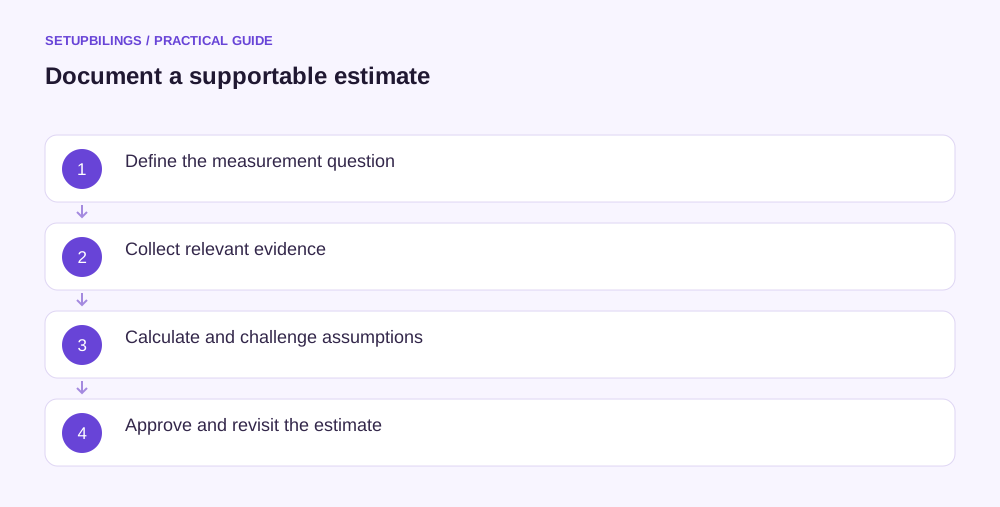
Accounting estimates are amounts determined through judgment where exact measurement is unavailable. They can involve doubtful customer balances, inventory obsolescence, asset useful lives and estimated obligations. Using estimates is a normal part of financial reporting; using unexplained numbers to obtain a desired result is not.
A reliable estimate identifies the question, relevant accounting requirements, evidence, assumptions and calculation. It also records who reviewed the conclusion and when it should be reassessed. Another competent person should be able to understand why the amount was selected without relying on the preparer’s memory.
Define what is being estimated
Consider an illustrative Kanpur appliance dealer with warranty obligations for products already sold. The estimate concerns the remaining expenditure required to settle qualifying warranty claims, not next year’s general repair budget or a preferred cash reserve.
Under AS 29, provision recognition first requires a present obligation from a past event, probable outflow and a reliable estimate. Measurement follows only after the recognition question is addressed. A careful spreadsheet cannot create an obligation that does not exist.
Write a one-sentence objective before gathering data: “Estimate the remaining qualifying repair cost for the covered sales population at the reporting date.” That scope prevents unrelated costs from being added and helps identify the data needed.
Build an evidence hierarchy
Start with relevant actual information: warranty terms, units sold, product types, claims received and repair costs. Consider whether recent quality changes or supplier issues make old experience less representative. Reconcile the covered sales population to reliable records.
Suppose, illustratively, the evidence supports an expectation of 40 remaining qualifying repairs at an average cost of ₹600 each. The simplified estimate is ₹24,000. This is not a prescribed percentage or a universal method; the appropriate approach depends on the obligation and applicable requirements.
If new evidence suggests repairs will cost ₹700 each, the same expected count gives ₹28,000. The ₹4,000 movement should be explained by the changed cost assumption, rather than described vaguely as a management adjustment.
| Estimate component | Evidence to retain |
|---|---|
| Covered population | Sales records and warranty terms |
| Expected claim pattern | Relevant claims history and current conditions |
| Cost per repair | Labour, parts and service evidence |
| Exclusions | Reasons costs fall outside the obligation |
| Selected amount | Calculation, judgment and approval |
For receivables, the evidence would differ: customer correspondence, disputes, payment history, security and subsequent receipts may be relevant. An estimate process should fit the item rather than apply one generic percentage everywhere.
Separate facts, assumptions and judgment
Facts might include the number of units sold and claims already paid. Assumptions might include future claim frequency or repair cost. Judgment explains why those assumptions are reasonable and how the applicable standard is applied.
Keep those elements visible in the workpaper. If a useful life is based on expected machine utilisation, record usage plans, maintenance information and obsolescence considerations. A statement that “management considers five years appropriate” is less useful than an explanation of the evidence supporting five years.
Avoid excessive precision. A calculation can be mathematically exact while its inputs remain uncertain. Explain a material range of outcomes or sensitivity where useful and required, rather than suggesting the final amount is certain because a spreadsheet displays two decimal places.
Apply a neutral challenge
Ask whether the same method would be used if profit were above or below target. A sudden change in assumptions whenever the business needs a stronger result can signal bias. Review both optimistic and pessimistic distortions.
Prudence requires appropriate caution, but not hidden reserves or excessive provisions. Deliberately understating an asset to create a future profit cushion is no more neutral than ignoring clear recovery problems. The selected amount should follow the evidence and the relevant measurement requirements.
Assign review to someone able to challenge the inputs. For significant technical or legal matters, obtain appropriate expertise. The owner should understand what that expert assessed and which uncertainties remain, rather than treating a report’s existence as proof that every accounting question is settled.
Update estimates when information changes
AS 5 recognises that estimates may need revision as circumstances, experience or available information change. Such revisions are distinct from correcting an error in the use of information already available. The applicable framework determines the resulting accounting and disclosure.
For the appliance dealer, compare actual claims with earlier expectations. If the difference comes from a new defect discovered after the original assessment, document the new evidence. If the original worksheet accidentally omitted half the covered sales, investigate an error rather than calling it simply a refreshed assumption.
Maintain opening estimate, additions, settlements, revisions and closing balance where relevant. Back-testing helps improve the next estimate and identify systematic overstatement or understatement. It should not be used to judge an earlier estimate solely with hindsight.
Retain the data version used for the estimate. A claims report refreshed after the accounts were prepared may contain events unknown at the original assessment date. Without a saved extract, later reviewers can struggle to distinguish changed information from an error in the original calculation. A dated input file, calculation and approval make that distinction easier and reduce unnecessary reconstruction.
Keep a concise estimate file
A practical file contains purpose, framework, data source, assumptions, calculation, sensitivity where useful, conclusion, reviewer and next review date. Link it to the ledger entry and any required disclosure.
Good estimates make uncertainty manageable and visible. Define the obligation or asset question, use current evidence, document the reasoning and revisit it when facts change. The business then has a supportable accounting amount and a clear explanation of the judgment behind it.