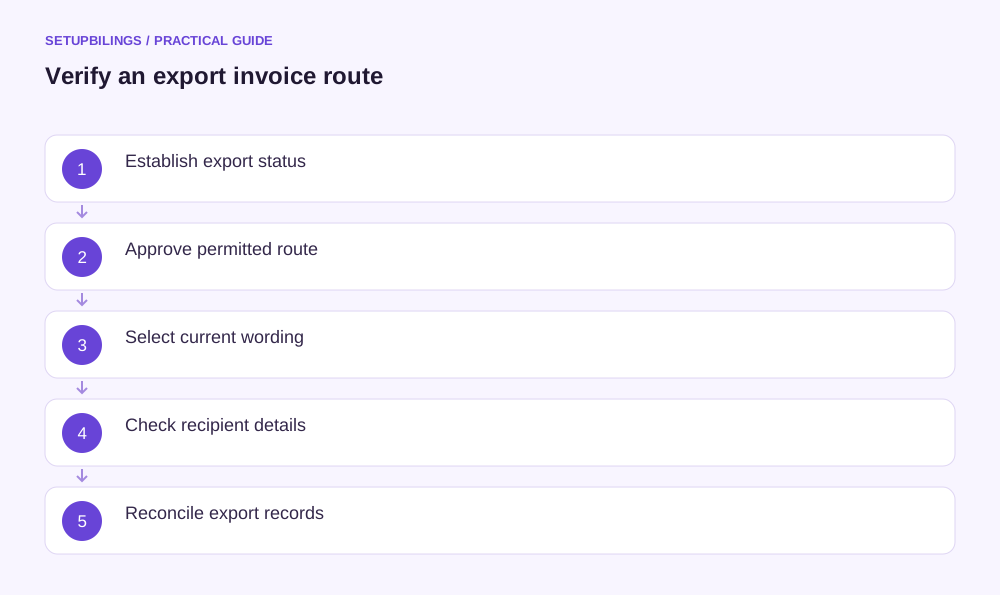
Verify an export invoice endorsement by first establishing that the supply qualifies as an export and identifying the permitted payment or bond/LUT route. Rule 46 provides endorsement wording and export recipient particulars. The endorsement should report the approved treatment, not create it. A foreign customer name, foreign currency or an overseas email address does not by itself establish every condition needed for an export of goods or services.
Confirm what is being exported
For goods, link the sale to the actual movement outside India and the relevant export records. For services, review the IGST Act's export-of-services conditions and place-of-supply analysis, including the parties' locations and establishment relationship. Obtain the contract and payment terms before classifying the invoice.
Keep export status separate from the customer's commercial description. An Indian company may pay for delivery to another country, while a foreign customer may purchase a supply whose GST place of supply remains in India. The facts and applicable provision determine treatment; the invoice heading should follow that conclusion.
Approve the route before choosing words
The zero-rated framework distinguishes supplies made without payment of integrated tax under the applicable bond or LUT conditions and supplies made on payment where the current permitted framework covers them. Check the operative section 16 provisions and relevant notifications rather than assuming every exporter can choose every refund route without restriction.
For the bond/LUT route, retain the relevant undertaking or bond records and period coverage. For a payment route, retain the eligibility conclusion and the tax calculation. Do not use a no-payment endorsement while recording a positive IGST collection, or a payment endorsement while the tax field and reporting show the opposite treatment.
Check the current Rule 46 template
The rule's endorsement distinguishes the payment and without-payment routes and also addresses SEZ supplies in its current wording. Use a controlled template drawn from the operative text and select the applicable supply route. Avoid typing an abbreviated slogan such as “export exempt” that can misdescribe zero-rated treatment.
For exports, the relevant route language includes payment of integrated tax or supply under bond or letter of undertaking without that payment. Verify the complete prescribed wording in the source before configuring the template. If software stores only a short internal code such as LUT, ensure the customer document renders the required endorsement rather than the unexplained code alone.
Illustrative route comparison
Assume a qualifying goods export with an approved taxable value of ₹2,00,000. Under a valid reviewed bond/LUT route without payment of IGST, the invoice records that route and no IGST amount is collected under it. Preserve the commercial value rather than describing the goods as having nil value.
For a separate hypothetical export eligible for the payment route, assume a confirmed aggregate IGST rate of 18%. IGST would be ₹36,000 on ₹2,00,000. These are alternative reviewed scenarios, not two amounts to show on one invoice. Refund eligibility and process require additional checks; neither example guarantees a refund merely because the endorsement appears.
Complete recipient and destination particulars
Rule 46's export provision requires the recipient's name and address, delivery address and country of destination in place of the specified domestic unregistered-recipient particulars. Record the actual contracting buyer and delivery destination accurately. A freight forwarder's address is not automatically the buyer's address.
For services, preserve the recipient identity and the contractual facts supporting location and supply treatment. Avoid inventing a physical goods destination for a service simply to populate a generic shipping field. Configure the invoice so the relevant information remains understandable for the actual supply type.
Align the invoice with export documents
Compare number, date, customer identity, value, currency, item description and route with applicable customs, transport and accounting records. For goods, reconcile relevant shipping references and quantities. For services, keep agreement, delivery evidence and payment realisation records appropriate to the export conditions.
Where foreign currency is used, retain the applicable GST valuation and conversion working. Do not assume the bank's eventual settlement amount is the only relevant conversion figure for every tax purpose. Differences from exchange movements should remain distinguishable from a change in the agreed supply value.
Control changes after issue
If the route or transaction facts change, review the issued invoice, relevant electronic invoice status, return reporting and export records together. A replacement PDF with different wording can leave inconsistent structured records. Preserve the original and document the approved correction process.
Do not let sales staff toggle the endorsement merely because the buyer asks for a different commercial invoice format. A request to remove tax can require a substantive route and eligibility review. The approved decision should identify what changed and whether the supply still satisfies the relevant export conditions.
Release with a route-specific checklist
Confirm export status, eligible route, supporting bond/LUT or payment records, exact current wording, recipient and destination particulars, value and tax consistency. Assign unresolved facts before dispatch or service billing. A generic export checkbox is insufficient for a transaction with missing location or eligibility evidence.
The useful endorsement is the final visible part of a complete export decision. When the contract, statutory conditions, route and records agree, the wording helps customers and reviewers understand the invoice. When they do not, adding an export label cannot repair the underlying treatment.