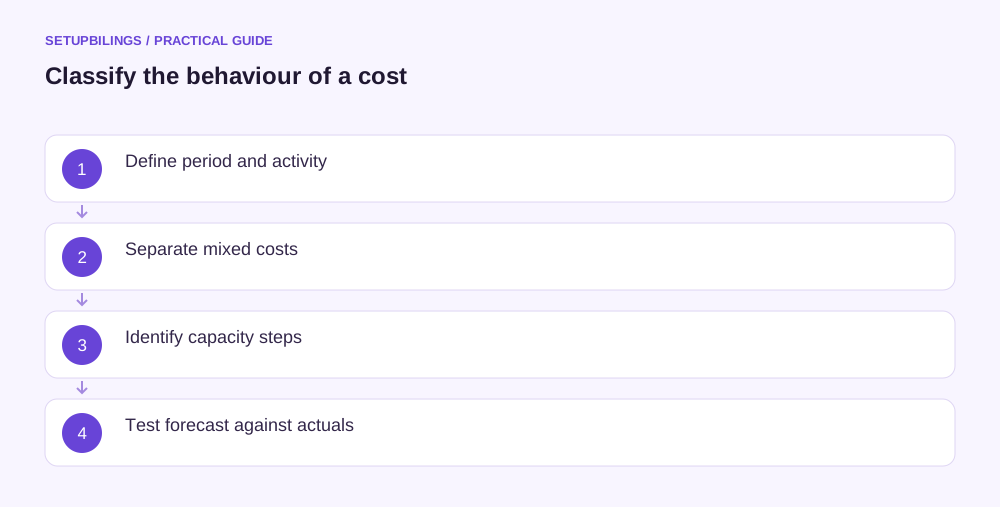
A fixed cost stays broadly unchanged as activity changes within a defined period and operating range. A variable cost changes with the activity that causes it. Classify spending against a specific driver, such as units produced, deliveries completed or billable hours. The name on the supplier invoice does not settle the question.
For an Indian small business, this distinction helps answer a practical question: if next month's orders increase, how much more will operating expenditure rise? It also prevents the opposite mistake of assuming every expense falls immediately when sales weaken.
Begin with a period and an activity measure
Consider an illustrative Nashik metal workshop planning one month at its existing premises. Monthly rent of ₹35,000 is fixed for this exercise. Steel costing ₹180 per finished bracket is variable with brackets made. A courier charge per dispatch varies with dispatches, which may differ from production units.
The same cost can behave differently over another period. Rent is fixed this month but changes when the workshop relocates. A salaried operator may remain on payroll during a quiet week, even though additional workers become necessary when a second shift begins. Write the period and operating range beside each classification.
ICAI's cost classification material distinguishes cost behaviour from other classifications. Fixed versus variable describes response to activity; direct versus indirect describes whether a cost can be traced to the item being costed. A dedicated machine's depreciation can therefore be both direct to one product and fixed for the month.
Build a cost behaviour register
Use recent invoices, wage records and contracts rather than relying only on ledger names.
| Spending item | Useful driver | Initial classification | Evidence to check |
|---|---|---|---|
| Workshop rent | Months occupied | Fixed | Lease and escalation date |
| Steel consumed | Brackets made | Variable | Bill of materials and yield |
| Electricity | Machine hours | Mixed | Standing charge and usage |
| Dispatch labour | Orders packed | Step cost | Staffing capacity per shift |
| Marketplace fee | Sales value | Variable | Channel agreement |
A mixed bill has a fixed and a variable component. If electricity includes a ₹4,000 standing charge and estimated usage of ₹12 per machine hour, the planning equation is ₹4,000 plus ₹12 multiplied by hours. The bill is neither entirely fixed nor entirely variable.
Step costs remain stable over a band, then jump. One dispatcher may manage 400 orders monthly; a second dispatcher may be required above that level. Do not spread the extra salary smoothly across every order if the staffing decision is actually indivisible.
Work through a monthly example
Suppose the workshop expects 1,000 brackets. Its planning assumptions are ₹60,000 fixed operating costs and ₹240 variable cost per bracket, including steel, consumables and activity-related power. Estimated operating cost is ₹60,000 plus ₹2,40,000, or ₹3,00,000.
At 1,200 brackets, the same assumptions produce ₹60,000 plus ₹2,88,000, or ₹3,48,000. Total expenditure rises by ₹48,000, while average cost falls from ₹300 to ₹290. The reduction comes from spreading the fixed amount over more units; it does not mean steel became cheaper.
Now assume 1,200 brackets require an extra supervisor costing ₹18,000. Cost becomes ₹3,66,000, or ₹305 per bracket. Ignoring that capacity step would understate the expansion cost by ₹18,000. This is why a forecast needs operating constraints beside its formulas.
Estimate mixed costs carefully
For a first estimate, compare two months with different activity but similar prices and operating conditions. If maintenance expenditure rose from ₹15,000 at 500 machine hours to ₹21,000 at 800 hours, the implied variable rate is ₹6,000 divided by 300, or ₹20 per hour. The implied fixed amount is ₹5,000.
Treat this as a hypothesis. A breakdown, annual service visit or changed spare-part price can distort the comparison. Check more months and ask the maintenance team whether the proposed relationship makes operational sense. A simple documented estimate is preferable to a statistically impressive relationship built on unrelated events.
Do not use purchase payments as a substitute for material consumption. Buying three months of steel raises cash outflow immediately, but does not mean the month's production used that entire quantity. Maintain separate consumption and payment views.
What should happen to an annual payment?
An annual software subscription paid in April can be a fixed monthly operating cost for planning even though its cash payment occurs once. If the fee is ₹24,000 for twelve months, the operating plan may show ₹2,000 monthly on the chosen accrual basis, while the cash plan shows the actual payment date.
The classification also depends on the contract. A subscription charging ₹500 per active user changes when users are added, whereas a flat organisation licence may remain unchanged. Read the charging mechanism before classifying the ledger account. The word “subscription” does not tell you whether the cost is fixed, variable or a step within the planning range.
Use the classification in decisions
Before accepting extra work, calculate the costs that the additional activity causes. Before cutting output, identify which costs can actually stop and when. A fixed label alone does not mean a cost is unavoidable forever; the relevant contract, notice period and decision horizon matter.
Review the register when prices change, a shift is added, outsourcing begins or delivery patterns alter. Give uncertain lines an owner and a review date. For major items, show a low and high estimate instead of hiding uncertainty in an unexplained contingency percentage.
Finish by reconciling the classified totals to your operating accounts for the same period. Every significant cost should appear once, with mixed components adding back to the original amount. A useful classification is one you can explain and update. Start with your ten largest expense lines, identify their drivers, and test next month's forecast against actual activity.