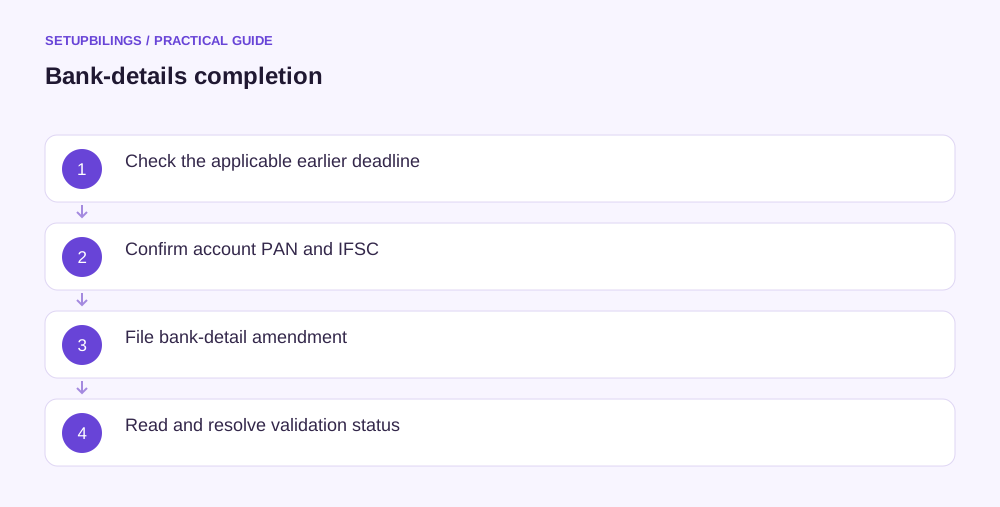
Bank details are a post-registration task
GSTN's normal registration manual explains that bank information is entered through an amendment after grant of registration. That does not mean it can be postponed indefinitely. For registrations covered by Rule 10A, the required timing is within thirty days from grant or before furnishing outward supply details in GSTR-1 or using the invoice furnishing facility, whichever is earlier.
Notification 38/2023-Central Tax replaced the older timing language. Do not use an outdated forty-five-day checklist. Rule 10A itself has category exceptions, including registrations under rules 12 and 16, and special registration types may have their own portal treatment. This article's working sequence is primarily for a normal business registrant adding its operating bank account.
Prepare the correct account information
Use an account genuinely connected to the registered person and check the PAN held by the bank. GSTN's validation guidance specifically compares the PAN registered under the GSTIN with the PAN maintained for the bank account. A director's personal account is not interchangeable with the company's account merely because the director owns the company.
Confirm the full account number and active IFSC from reliable bank evidence. Review changes caused by branch mergers or account migration rather than copying an old cheque without checking it. Prepare the supporting bank document requested by the live form and ensure it shows the relevant name, account and branch details legibly.
Keep bank information in a controlled business folder. Someone preparing the portal entry should not have to collect account details from several unverified chat messages. Where records disagree, resolve the discrepancy with the bank before submission instead of trying multiple guessed combinations until one appears to work.
Plan against the earlier deadline
Create a post-approval checklist immediately when the GST certificate is available. Record the grant date and the planned date of the first GSTR-1 or IFF submission. The earlier event determines the practical deadline under the Rule 10A wording; a business filing early cannot simply wait for the thirtieth day.
Illustratively, a new trader receives registration on 5 May and plans to furnish its first outward supply statement on 15 May. It should arrange the required bank information before that filing, even though thirty days from grant have not elapsed. Conversely, delaying the first statement beyond thirty days does not remove the thirty-day limit.
GST Council's December 2025 newsletter records portal enforcement, including automatic suspension for failure to furnish bank details within the prescribed period. Check any actual notice or order in the account if the task is already overdue. Adding details and resolving an existing suspension are connected tasks, but the final account status should still be verified.
Enter the details through the portal
Log in to the official GST portal and use Services, Registration and Amendment of Registration Non-Core Fields. Open the bank section, add the correct information and upload the required proof. Check each digit against the source record, especially when an account number contains repeated or leading digits.
Enter the reason and date requested, review the application and submit through the authorised person using the permitted signing method. GSTN's manual describes the final verification step and success message. A draft entry or an uploaded cancelled cheque does not, by itself, complete the amendment.
Retain the application and acknowledgement. If replacing an existing bank account, check the live form's conditions: GSTN guidance says the only listed account cannot simply be deleted and another must be added before removing the previous one. Plan the replacement to preserve an accurate, usable bank record rather than leaving no account listed.
Read the validation status precisely
After filing, open My Profile and Bank Account Status. GSTN sends details for online validation and displays the result as a status icon with an explanatory message. Read that message rather than interpreting a coloured icon without context. “Pending” is a processing state, not the same as a confirmed failure or successful validation.
A PAN mismatch requires checking the GST applicant and bank PAN. An inactive IFSC requires the correct active branch information. Other messages may concern missing PAN, account description, account type or bank formalities. The remedy should match the stated issue; re-entering the same information repeatedly does not correct a bank-side record.
If the message asks the taxpayer to complete formalities at the bank, do that first and then use revalidation when the portal permits it. GSTN's guidance notes conditions and limits around revalidation. Keep the bank confirmation and the portal result so the business can show what changed and when.
If two bank accounts are listed, review both status messages rather than assuming a successful first account validates the second. Keep a note identifying the operating purpose of each account so future replacements do not remove the wrong record.
Confirm completion beyond the bank entry
Check that the account remains correctly listed and that its validation status is understood. If suspension or cancellation proceedings were initiated, review the relevant notices and resulting status. The December 2025 Council update describes the portal route for dropping proceedings after bank details are furnished, including a manual initiation option where automatic action does not occur as described.
Do not assume changing GST bank details automatically redirects every refund, customer payment or bank mandate. Review those workflows separately where relevant. Likewise, a successful bank validation does not confirm the accuracy of sales, input credit or returns; it establishes a narrower account-validation result.
Assign an owner to monitor account closures, IFSC changes and bank PAN updates. Keeping this file current helps avoid an otherwise preventable filing interruption and leaves a clear record of the registered person's valid bank information.