Budget for new equipment by estimating the full acquisition and implementation cash requirement, the working capital it creates and the effect on existing operations. Schedule payments and confirmed funding by date, then test whether the business retains enough cash through installation and ramp-up. The supplier's machine price is only the starting point.
Keep three views connected: the investment's economic benefit, the cash funding schedule and the accounting treatment. An attractive payback estimate does not prove the business can fund the deposit, and a cash payment is not automatically part of the asset's carrying cost.
Define the operating problem first
Consider an illustrative Coimbatore food-packaging unit considering a new sealing machine. Management wants fewer bottleneck delays and more consistent seals. It confirms the product sizes, required throughput, power, space, operator skills and service support before comparing quotations.
Check whether maintenance, a process change or outsourcing could solve the problem at a different cost. Equipment should be assessed against a credible alternative, including continuing with the existing process where that is feasible.
ICAI's investment-decision material focuses on incremental project cash flows, while AS 10 governs qualifying property, plant and equipment costs under that framework. The budget should support both the investment decision and the separate accounting assessment.
Build a complete implementation cash list
The following amounts are illustrative and assume any tax recovery facts have been separately assessed.
| Cash requirement | Amount |
|---|---|
| Machine price | ₹8,00,000 |
| Freight and handling | ₹30,000 |
| Installation and testing | ₹50,000 |
| Electrical and site preparation | ₹40,000 |
| Training and transition expenditure | ₹20,000 |
| Initial spares and consumables | ₹10,000 |
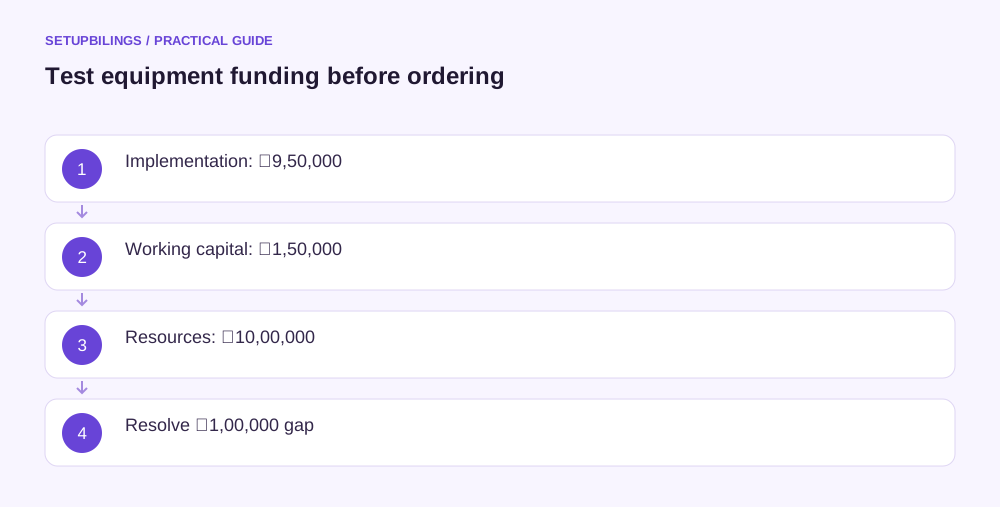
| Acquisition and implementation cash | ₹9,50,000 |
| Additional operating working capital | ₹1,50,000 |
| Total planned funding requirement | ₹11,00,000 |
The table is a cash budget, not a declaration that every item is capitalised. AS 10 distinguishes directly attributable costs from excluded items, including specified opening, training and initial operating expenditure. Assess each actual item under the applicable framework rather than capitalising the whole project spreadsheet.
Include actual tax payments even where recovery may occur later. Their timing can affect the funding gap while their ultimate cost treatment differs.
Match the payment milestones with funding
Suppose a confirmed equipment facility provides ₹6,00,000, subject to its actual disbursement conditions. Existing business cash is ₹7,00,000, but management needs ₹3,00,000 for ongoing operations. Only ₹4,00,000 is available for the project on that basis.
Total identified resources are therefore ₹10,00,000 against ₹11,00,000 planned need, leaving ₹1,00,000 unresolved. Do not use the protected ₹3,00,000 implicitly and then describe the project as fully funded.
Schedule the supplier deposit, dispatch payment, acceptance balance and ancillary works separately. A facility disbursed after delivery may not fund an earlier deposit. Confirm which invoices and costs the funding actually covers and when the money can be used.
Budget the transition in production
Installation may stop an existing line, require temporary outsourcing or produce slower output while operators learn. Estimate the contribution lost or extra costs caused by that transition. Keep the same effect from appearing twice as both lost sales and a full duplicate expense without a proper bridge.
Allow for testing, product approval and a realistic production ramp-up. A machine capable of a stated throughput may not immediately produce accepted saleable output at that rate with the firm's materials and staffing.
Plan commissioning responsibilities and acceptance criteria. The business needs to know who resolves failed tests, delays or missing accessories before a large balance becomes payable.
Check the operating benefit and working capital
Estimate additional contribution or avoidable costs using actual demand and process constraints. More output has value only where customers can buy it or where it replaces an identifiable cost. Do not multiply nameplate capacity by selling price and call the total a benefit.
The extra output may require more material stock and customer-credit funding. The example includes ₹1,50,000 additional working capital, but the actual requirement should follow stock and collection assumptions. If sales ramp more slowly, the benefit may be delayed while some costs continue.
Simple payback can provide an initial view, but it ignores important timing and later-flow differences. For material investment choices, evaluate the appropriate incremental cash flows over the project's life, including relevant tax effects based on the business's actual facts. Avoid using an assumed tax rate as a universal input.
Include future commitments
Add maintenance, service visits, software, consumables, insurance and relevant financing payments to the ongoing forecast. Confirm whether quoted warranties cover labour, travel, parts and the circumstances the business expects.
If old equipment is sold, use supported disposal proceeds and a realistic date. Do not depend on a speculative resale value to fund a fixed near-term commitment. Assess the accounting and tax consequences separately where they affect the decision.
Keep one person responsible for commissioning dependencies
Site readiness, electrical work, delivery and operator availability need coordination. Assign an owner to the combined schedule so that a completed machine does not arrive before the workshop can receive, install and test it.
Release the order with a clear cash condition
Before commitment, reconcile the project requirement with usable resources and the weekly operating cash forecast. Resolve the ₹1,00,000 illustrative gap or change the project scope or timing. Name the person responsible for each unresolved implementation assumption.
After commissioning, compare actual cash, downtime, output and quality with the approval case. Equipment budgeting succeeds when the business can install and use the asset while continuing to pay for ordinary operations, and when the expected benefit is later tested against what the machine actually delivers.