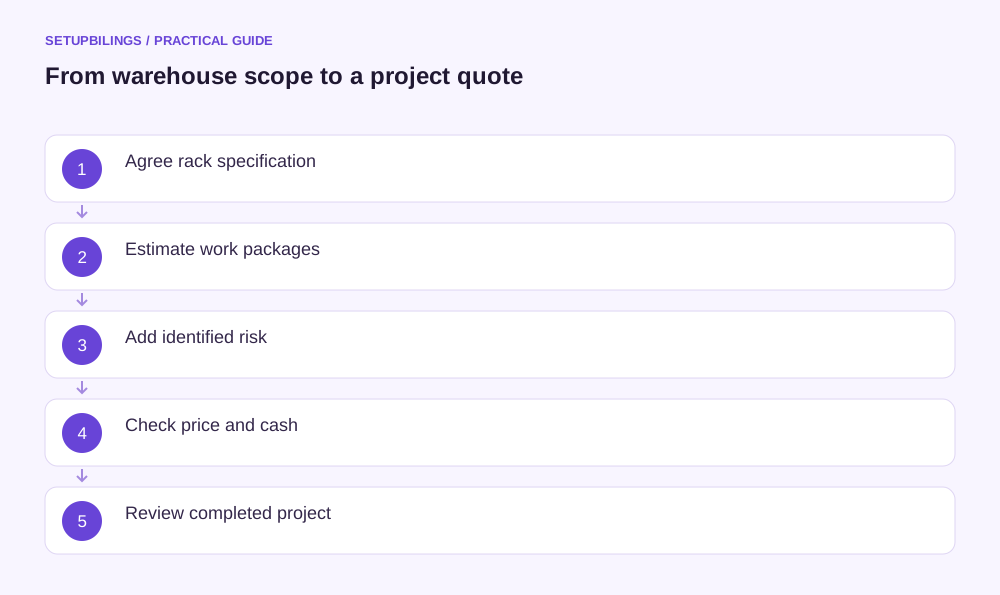
Build a project cost estimate by defining the deliverables, dividing the work into manageable tasks, estimating resources for each task and adding the shared costs and specific risks the project consumes. Do this before selecting a selling price. A rounded quote based only on a competitor's number can conceal work that your team still has to perform.
The estimate should be detailed enough to explain its biggest cost drivers, while remaining simple enough to update when scope changes. For an MSME, a clear worksheet linked to supplier quotes and responsible people is often sufficient.
Freeze a usable scope
Consider an illustrative Hyderabad contractor quoting for storage racks in a small warehouse. The customer wants 30 bays, installation, anchoring and a handover inspection. The estimate records dimensions, load requirements, site access, delivery location and who provides unloading equipment.
Write exclusions and assumptions in concrete terms. “Installation included” is incomplete if the team assumes clear daytime access but the customer expects overnight work around live operations. Clarify removal of old fixtures, civil work, power supply and whether the site is ready.
ICAI's job-costing material supports separate collection of material, labour, expenses and overheads for an individual job. A project estimate uses the same discipline prospectively: each important amount should relate to a defined piece of work.
Estimate quantities and effort by work package
The contractor builds the following illustrative estimate, using net amounts on a consistent cost basis.
| Work package | Estimation basis | Cost |
|---|---|---|
| Rack materials and fabrication | Supplier quote for 30 bays | ₹3,60,000 |
| Transport and unloading | Confirmed vehicle and handling plan | ₹24,000 |
| Installation labour | 160 hours × ₹300 | ₹48,000 |
| Anchors and consumables | Quantity schedule | ₹18,000 |
| Site supervision and inspection | 40 hours × ₹400 | ₹16,000 |
| Allocated project support | Documented support estimate | ₹20,000 |
| Base estimated cost | Total above | ₹4,86,000 |
The labour rates must have a defined boundary. If ₹300 per hour already includes employment overhead, do not add that same overhead again. If it is only the direct wage rate, identify the additional cost needed to produce a sustainable estimate.
For purchased items, record quotation date, validity, delivery terms and specification. An apparently cheaper quote may exclude freight, installation or a necessary component. Compare like-for-like scope before choosing the input cost.
Estimate risk from identifiable events
The contractor identifies a possible extra day's access restriction, estimated at ₹12,000 if it occurs. Management includes a ₹12,000 allowance because the site conditions remain unresolved. Estimated project cost becomes ₹4,98,000.
This is a stated planning allowance, not a claim that every project needs a standard contingency percentage. Record the event, cost consequence and person who can resolve it. If the customer confirms uninterrupted access before acceptance, management can reassess the allowance.
Avoid hiding risk in inflated material quantities, labour hours and a separate contingency simultaneously. That can count the same uncertainty several times and make the estimate difficult to challenge. Separate base quantities from risk allowances.
Translate cost into a commercial quote
If the contractor targets a 20% margin on project revenue using the ₹4,98,000 cost estimate, required price is ₹6,22,500. A 20% markup would give ₹5,97,600 instead, so the approval record must say which method applies.
Then test whether the proposed offer is competitive for its actual scope. If the customer budget is ₹6,00,000, identify a genuine scope or cost change rather than simply assuming installation will take fewer hours. The difference should lead to a documented commercial choice.
Keep any applicable tax calculation separate and correct for the actual transaction. A management estimate does not determine classification, tax rate or input credit eligibility. Those facts belong in the quotation review where they affect amounts charged or costs retained.
Check payment timing and execution capacity
Suppose materials require ₹1,80,000 upfront but the customer offers only a ₹60,000 advance. The project may show a reasonable margin while creating a funding gap before installation. Schedule deposits, supplier payments, payroll and expected milestone receipts by date.
Check team availability as well. A 160-hour estimate is not a delivery plan if the required installers are already committed elsewhere. Overtime, subcontracting or delayed completion can change cost and customer acceptance.
Agree how variations will be approved. Additional rack bays, changed site dimensions and repeat visits should have clear pricing or approval rules. Record customer requests before performing extra work so that scope growth does not appear later as unexplained inefficiency.
Who should challenge the estimate?
Ask the person responsible for delivery to review the largest quantities and labour assumptions before the quote is approved. Purchasing should confirm supplier scope, and the person managing collections should check whether proposed milestones are practical. This is a focused review of material assumptions, not a requirement for every small line to pass through several approvals.
For the rack project, installation hours, material specification and site access deserve more attention than an immaterial stationery allowance. Record the reviewer's unresolved questions beside the relevant work package. The final approval should state which assumptions remain conditional and what must be confirmed before procurement begins.
Review the estimate after completion
Keep the original approved estimate and a separate revised version for authorised changes. Compare actual quantities, hours and supplier costs with both. This shows whether the quotation was wrong, execution changed or the customer added work.
Finish each project with one or two corrections for the next estimate, such as a better installation-hour allowance or a more precise unloading assumption. Reliable project quoting improves through that feedback loop: define work, estimate resources, expose uncertainty, check cash and capacity, then learn from the completed job.
Give the estimate a version number and retain the supplier evidence used at approval. If a quote is reopened months later, the team should be able to identify which rates expired and which scope assumptions still hold.