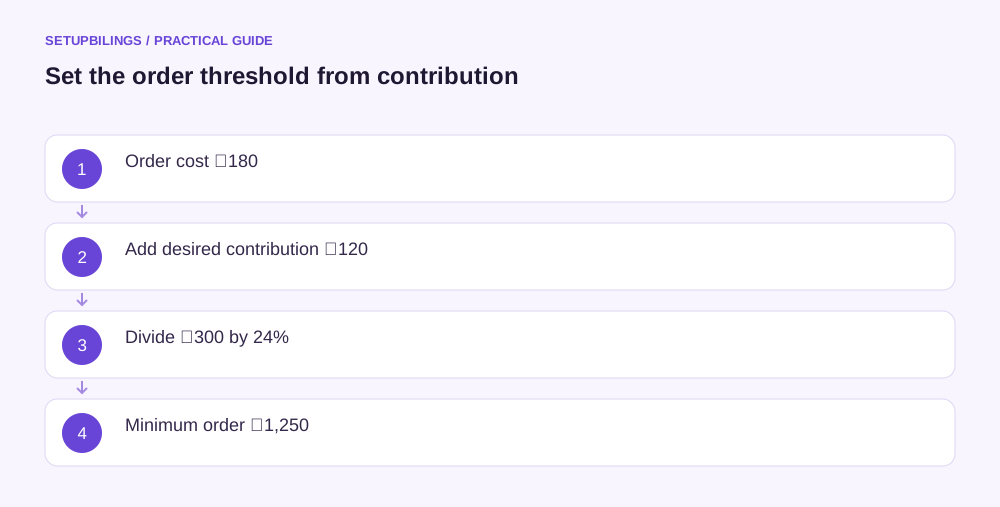
A minimum order value should cover the costs caused by processing and fulfilling an order, using the contribution available from its products. A useful starting formula is order-specific cost divided by the product contribution ratio. Add any required contribution towards wider overheads or profit before dividing if the policy is intended to cover more than the order itself.
The result is a commercial policy, not a universal accounting threshold. Customer mix, delivery routes, repeat business and available capacity can justify different rules. Begin by understanding which costs occur per item and which occur once per order.
Separate the two types of spending
Consider an illustrative Indore distributor supplying cleaning products to offices. After stock cost and item-related sales charges, its normal product mix generates 24% contribution on net sales. Picking paperwork, packing materials and local delivery create an estimated ₹180 incremental cost per order.
At a 24% ratio, ₹180 divided by 0.24 gives a ₹750 order value to cover those order-specific costs. A ₹750 order generates ₹180 product contribution and leaves nothing after the ₹180 fulfilment amount. It has not yet contributed towards shared rent, management or profit.
If the business wants another ₹120 per order for shared costs and profit, the threshold becomes ₹300 divided by 0.24, or ₹1,250. State this objective explicitly. A minimum intended merely to avoid an incremental loss should not be advertised internally as a guarantee of full profitability.
Show the order economics
| Illustrative order value | Product contribution at 24% | Order-specific cost | Amount left for shared costs and profit |
|---|---|---|---|
| ₹500 | ₹120 | ₹180 | ₹60 shortfall |
| ₹750 | ₹180 | ₹180 | Nil |
| ₹1,250 | ₹300 | ₹180 | ₹120 |
| ₹2,000 | ₹480 | ₹180 | ₹300 |
The table assumes the same product mix and fulfilment cost at each order size. A heavy ₹2,000 order requiring a dedicated vehicle may not fit that assumption. A customer collecting a ₹500 order may cost much less to serve than the delivery case.
ICAI's activity-based costing material explains why order count and other activities can drive shared resource consumption. For a practical minimum-order policy, distinguish costs that truly increase with an additional order from allocated costs that describe longer-term resource use.
Measure the order cost instead of guessing
Review a representative set of orders. Record picking time, invoicing effort, packing, delivery distance, failed delivery and collection activity. Use observed wage and transport costs to estimate the resources involved. Separate ordinary orders from bulky, urgent or remote deliveries.
For staff already on fixed salaries with spare time, additional order-handling minutes may not create an immediate wage payment. They still consume capacity. Show both the short-term incremental cost and a sustainable service-cost estimate if the volume of small orders could require more staff later.
Do not count delivery twice. If delivery cost is already included in the 24% contribution calculation, remove it from the separate ₹180 amount. Similarly, distinguish an order-level packaging carton from packaging already included in each product's variable cost.
Compare policy options
A strict ₹1,250 minimum is only one choice. The distributor could allow smaller orders with a transparent delivery charge, offer fixed route days, permit collection or combine several requirements into one weekly order. Each option changes either customer behaviour or fulfilment cost.
Suppose a weekly route reduces incremental delivery and handling cost from ₹180 to ₹120. The order value required to cover that amount falls to ₹500 at the same 24% contribution ratio. If the owner still wants ₹120 towards shared costs and profit, the corresponding threshold becomes ₹1,000.
A delivery fee also needs a calculation. A ₹600 order yields ₹144 product contribution. With ₹180 order cost, the immediate gap is ₹36 before any other fee-related expense. A ₹50 charge may cover that gap, but customer acceptance and the actual tax treatment of charges require separate attention.
Account for product and customer differences
A single minimum can mislead when product contribution varies widely. At a 15% ratio, covering ₹300 requires ₹2,000 sales. At 30%, it requires ₹1,000. Consider broad product or service bands rather than dozens of confusing exceptions.
Review important customers over a suitable period. A small urgent replenishment might support a profitable recurring account, while frequent tiny orders with repeated delivery failures may remain expensive. Use evidence of actual account economics, not an untested promise that every small customer will become large.
Keep credit risk and payment delays visible. An order that covers picking and delivery can still consume collection effort or tie up cash. Avoid hiding those issues inside an unexplained increase in the minimum.
How should recurring scheduled orders be treated?
A standing weekly order may be cheaper to process than an equally sized urgent order because the warehouse can plan the pick and combine the route. Measure the actual activity before assuming both deserve the same threshold. Any special treatment should have an understandable reason and a simple eligibility rule.
For example, a fixed Tuesday delivery can be offered at a lower minimum if the route saves enough cost. Review missed collections, last-minute changes and repeat visits to confirm that the saving occurs. A policy based on scheduled efficiency loses its logic when staff routinely provide unscheduled service at the same lower threshold.
Trial the threshold and review behaviour
Apply the proposed rule to recent orders before launch. Estimate which customers would combine purchases, collect stock, pay delivery charges or leave. Then pilot the policy with a clear explanation and straightforward exceptions process.
Track contribution after fulfilment, order frequency and customer retention. Revisit the threshold when delivery costs or product mix change. A useful minimum order value makes small-order economics understandable and gives customers practical ways to order efficiently, while protecting the resources the business needs to serve them reliably.