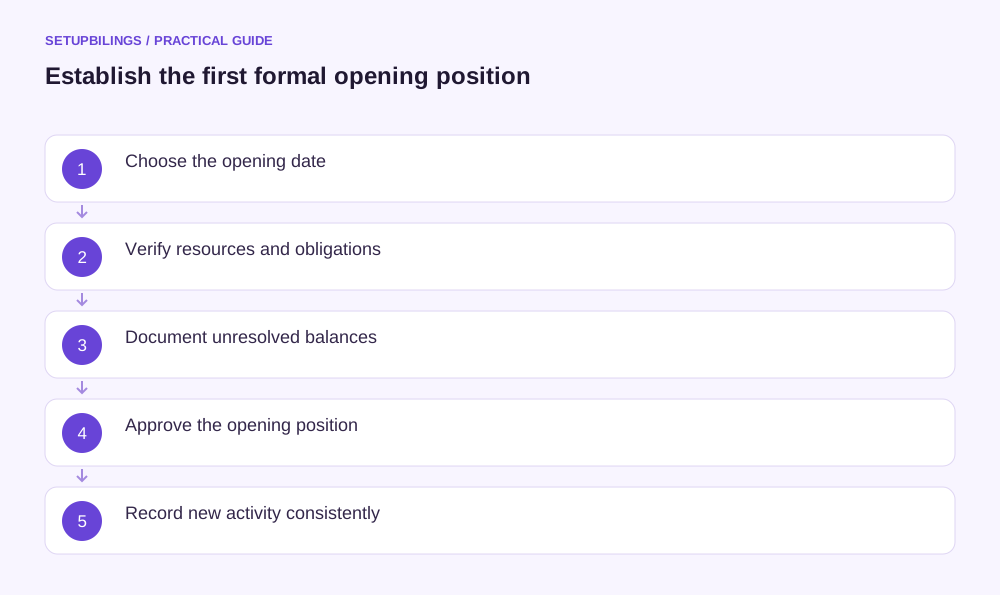
To establish formal accounts for an existing business, choose a clear opening date and build a supported picture of its assets, liabilities and owner’s interest at that date. Then record all subsequent transactions consistently. The task is not to invent a neat starting balance; it is to reconstruct the financial position from available evidence and identify what remains uncertain.
Starting new books does not erase earlier obligations or reporting requirements. Historical reconstruction and current recording may need to proceed together, with clear responsibilities. Establish the entity’s legal and accounting requirements before deciding the opening process.
Set the date and collect the evidence
Consider an illustrative Bareilly electrical repair proprietor moving from informal notebooks to formal records on 1 April. Collect bank statements, cash records, customer invoices, supplier bills, loan statements, equipment documents, deposit agreements and owner-transfer evidence around that date.
Ask staff and the owner about unrecorded credit sales, unpaid services, customer advances and personal payments for business costs. A bank statement alone cannot establish all balances. It may show payment but not whether stock remains, a service was received or a liability still exists.
Preserve the existing notebooks and messages. They may provide valuable transaction evidence even if they are incomplete. Create an index so reconstruction work can be followed by another preparer.
Establish assets individually
Count physical cash and reconcile bank balances to statements, explaining outstanding items. Build customer balances from invoices, credits, receipts and disputes rather than accepting a single remembered total.
Count stock and value it under the relevant requirements. If the count occurs after the opening date, reconstruct movements between the dates where reliable evidence permits. Do not describe a later count as if it occurred earlier without that reconciliation.
For equipment, identify ownership, purchase date, cost, use and relevant accumulated depreciation or other adjustments. An owner’s current estimate of resale value is not automatically the correct opening carrying amount. Deposits, advances and other assets need their own terms and recovery assessment.
Identify liabilities before deriving capital
List supplier bills, services received but not billed, loans, employee dues and other obligations. Obtain supplier and lender statements where helpful and reconcile differences. Ask about goods received on credit that were never entered in a notebook.
Customer advances need particular attention. Money already received may relate to work still owed, rather than retained profit available to the proprietor. Likewise, owner or family funding may be capital or a genuine repayment obligation depending on the arrangement.
An illustrative supported opening schedule might be:
| Opening balance | Amount |
|---|---|
| Cash and bank | ₹2,00,000 |
| Inventory | ₹2,00,000 |
| Equipment carrying amount | ₹3,00,000 |
| Customer receivables | ₹1,00,000 |
| Total assets | ₹8,00,000 |
| Supplier and other payables | ₹1,80,000 |
| Loans | ₹2,20,000 |
| Residual proprietor capital | ₹4,00,000 |
The capital amount is assets less liabilities on these simplified facts. It is a residual after establishing the other balances, not evidence that every asset and obligation is correct. A missing loan would falsely increase capital.
Separate known amounts from unresolved items
Maintain an opening-issues log with balance, evidence, uncertainty, proposed treatment, responsible person and deadline. Some amounts may need reasonable estimates under the relevant requirements. Document their basis and obtain review rather than hiding them inside capital or miscellaneous expenses.
A disputed ₹35,000 customer balance, for example, needs both the original transaction evidence and a recovery assessment. The fact that the customer appears in an old notebook does not prove the full amount remains due or collectible.
Avoid broad balancing entries to make schedules agree. Investigate whether differences arise from omitted transactions, duplication, personal movements, dates or incorrect classification. If a temporary holding approach is used, keep it controlled and do not present unresolved figures as final.
Prevent duplication at the cut-over
Once opening receivables and payables are recorded, later collection or payment clears those balances. It should not create a second sale or purchase. Link the opening items to invoice and bill references so settlement is workable.
Similarly, an opening inventory amount should connect with the chosen stock system and later cost-of-sales process. Equipment should enter an asset register with the information needed for depreciation and disposal. Importing totals without detail may produce a balanced ledger but leave operations unable to use it.
Test a few opening settlements before processing a large volume. Confirm that customer receipts, supplier payments and credit notes reach the right balances and do not distort current-period performance.
Record the cut-over approval and which schedules remain provisional. The owner and preparer should share one opening balance set, with controlled revisions as evidence is resolved. If different spreadsheets carry different opening stock or loan totals, later reports become difficult to reconcile. Communicate each material opening adjustment and its effect rather than allowing competing starting positions to persist.
Start a repeatable close
Adopt a suitable chart of accounts, dedicated document collection process and regular bank reconciliation. Review unpaid bills, advances, stock, accruals and prepayments each month. Keep owner introductions and withdrawals separate from business income and expenses.
Arrange a review of the opening position and any historical reporting consequences with the appropriate preparer. The required scope depends on entity, available records and applicable obligations. A new system is the beginning of control, not proof that earlier issues have been resolved.
Formal accounts become dependable through a supported opening position and consistent later recording. Establish each balance, preserve its evidence and make uncertainty explicit. The owner can then build useful reports on a foundation that another person can understand and verify.