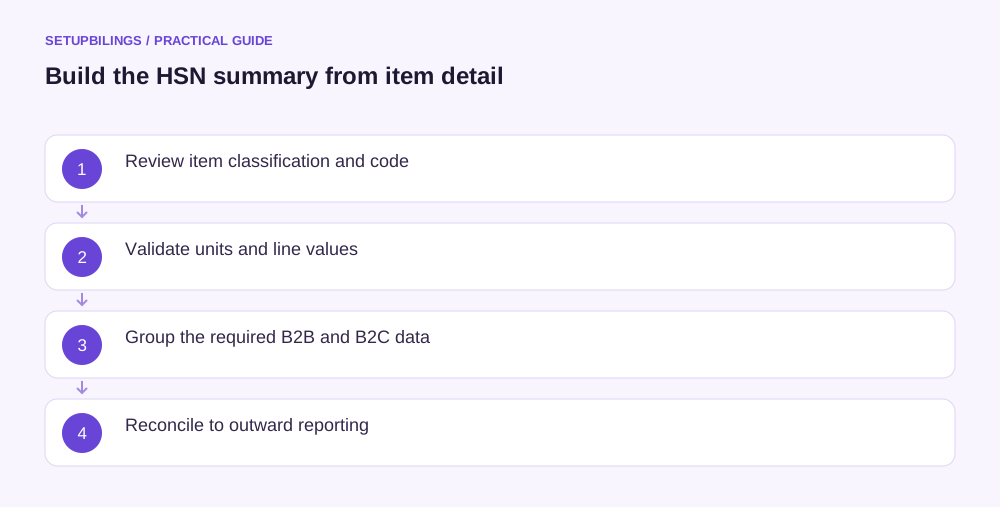
Prepare an HSN-wise sales summary by mapping each item or service to a reviewed code, retaining quantities and units where relevant, and grouping the period’s values under the current return requirements. Do not assign codes only after the sales total has been finalised; item-level mistakes become difficult to identify once everything is aggregated.
GSTN’s Table 12 changes from the May 2025 period introduced separate B2B and B2C tabs and code-selection controls. Its guidance uses the preceding financial year’s aggregate annual turnover for the four-digit or six-digit reporting requirement. Keep the underlying classification decision separate from the number of digits displayed.
Review the item master first
Consider an illustrative Ludhiana tools distributor with several item descriptions for the same product family and some service invoices for repairs. A sales export may label one item “hand tool,” another by brand name and another by an internal stock code.
Identify the actual goods or service, specification and classification basis. A similar commercial description does not prove that two products share an HSN, and a brand name is not a legal classification method. Escalate uncertain items for a supported classification review.
Maintain code, description, unit, applicable tax treatment, effective dates and reviewer in the item master. Rates and classification can change, so preserve the version relevant to the transaction date. Do not overwrite history with today’s code or rate and assume earlier invoices automatically change.
Apply the relevant digit requirement
GSTN’s guidance requires four-digit reporting for taxpayers with preceding-year AATO up to ₹5 crore and six-digit reporting where it exceeds ₹5 crore in the relevant Table 12 process. Verify the applicable turnover basis and current instructions for the period.
A four-digit requirement is not permission to guess a broad heading unrelated to the goods. The business still needs a defensible classification. Similarly, a longer code that passes a dropdown check does not prove that it describes the product correctly.
The May 2025 advisory phased validations and described some B2C controls differently from B2B controls. Prepare complete underlying data and review the current live validation rather than assuming every warning is a permanent exemption from accurate reporting.
Preserve line-level values and quantities
Extract document number and date, recipient category, item code, HSN or SAC, unit, quantity, taxable value and tax heads. Distinguish invoice lines, notes and amendments so their effects are applied correctly.
Suppose two illustrative product lines share the same verified code, unit and relevant tax treatment. One has 20 units at ₹1,000 and the other 30 units at ₹800, giving total taxable value ₹44,000 for 50 units before other adjustments. At an assumed valid 18% rate, tax would be ₹7,920.
| Grouping check | Why it matters |
|---|---|
| Same reviewed code | Avoid combining different classifications |
| Consistent unit | Do not add kilograms to pieces |
| B2B or B2C tab | Keep the required reporting populations distinct |
| Taxable value | Reconcile with reviewed outward records |
| Tax heads and adjustments | Preserve the correct net effect |
The assumed rate is for arithmetic only. Actual rates, exemptions and other levies must be verified for the specific item and date, rather than inherited from the example.
Handle units and mixed records carefully
If the business sells the same item in boxes and individual pieces, use supported conversion data where a common quantity basis is appropriate. Do not add 10 boxes and 20 pieces as 30 units without explaining the relationship.
Services may require different quantity treatment from goods under the relevant return instructions. A blank or standard quantity convention should follow the applicable requirements, not an attempt to make the spreadsheet look uniform.
Credit notes, returned goods and amendments need a clear sign and period logic. GSTN’s validation guidance considers differential values for relevant amendments. Re-entering the full revised invoice value as an additional HSN amount can overstate the summary.
Reconcile with the correct outward categories
Compare the B2B and B2C summary values with the corresponding reviewed GSTR-1 tables using the portal’s defined mapping. Some categories, including exports, can sit in a validation grouping that differs from an employee’s informal use of “B2C.” Follow the actual form mapping.
Investigate unmapped items and records with missing codes. A residual “other” row should not absorb them without classification support. Also review zero-value or unusual negative groups, because they may arise from duplicated notes or incorrect sign handling.
Check whether auto-populated e-invoice HSN data agrees with the approved item master. A system-supplied code is still subject to the business’s classification responsibility. Preserve the source and correction trail.
Keep a record of manual code overrides and why they were approved. If an item is mapped differently for one transaction, investigate whether its specification, supply arrangement or effective date actually differs. An unexplained override can make the summary inconsistent and hide an item-master problem. Review the exception before it becomes the default for later invoices or is copied into the next reporting period.
Approve and maintain the summary
Keep the item-master version, extraction date, transformation rules, exceptions and final Table 12 values together. After changing source records, regenerate the summary and reconcile again before filing. Do not approve an earlier summary while uploading a later file.
Use recurring errors to improve the master. If staff repeatedly select the wrong code for a service bundled with goods, review the underlying supply and billing process instead of correcting only the last spreadsheet.
An HSN summary is reliable when classification and units are correct before aggregation. Maintain reviewed item records, apply the relevant digit and tab requirements and connect every grouped amount back to the outward-supply population. That gives the final table a supportable basis beyond a matching grand total.