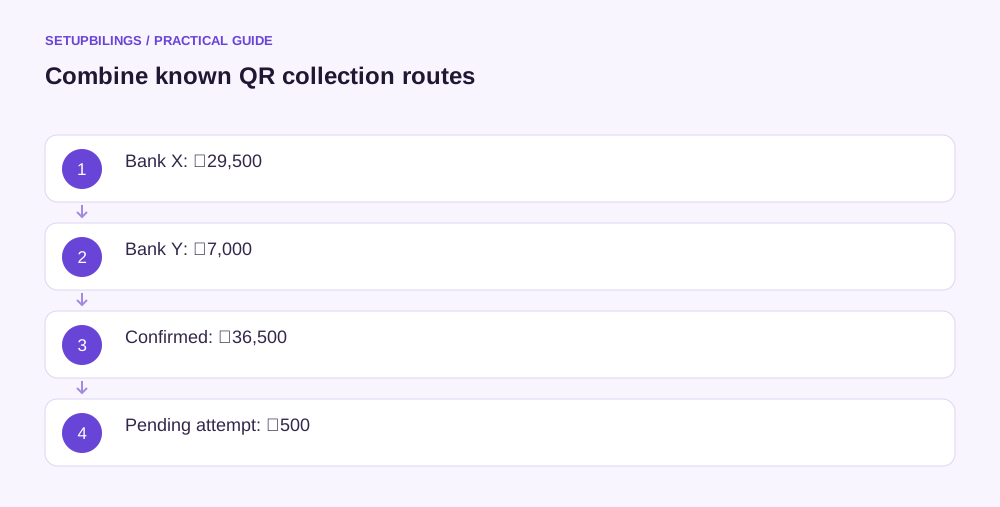
Reconcile collections from several business QR codes by maintaining a clear map of each QR, counter or location, merchant identity and receiving bank or provider route. Match transactions within that route, then combine the results. Do not assume all QR codes credit the same account or that one bank statement contains every collection.
A QR is a payment entry point, not an accounting account by itself. The receiving arrangement and transaction evidence determine where the money appears. A useful control connects the displayed QR with the actual merchant record, bank or provider and sales location.
Build a QR register with effective dates
Consider an illustrative Nagpur hardware business with a main counter, trade counter and delivery QR. It records a unique internal label for each display, its location, provider or merchant identifier, intended receiving account and person responsible.
When a QR is replaced or its receiving arrangement changes, record the effective date and preserve the old mapping for earlier transactions. Do not overwrite history so that last month's collections appear to belong to the new account.
BHIM's official information describes QR-based UPI payments and the use of a virtual payment address. For reconciliation, verify the actual QR and merchant details through the bank or provider arrangement in use rather than assuming a generic QR label identifies the settlement account.
Confirm the sales expected through each route
Obtain the counter or delivery sales report with payment method and bill references. Check split payments, returns and bills that staff marked paid before receiving-side confirmation. Keep the same shift or day cut-off across the reports.
Staff should identify which QR was used where that affects the collection trail. A single undifferentiated UPI total can hide money credited to another business bank account or a provider balance.
Use transaction identifiers, amount, time and the relevant sale together. Several QR codes can receive identical amounts on the same day, so matching only date and value is insufficient.
Work through an illustrative daily map
The hardware business records the following day-end position:
| QR route | Expected UPI collections | Confirmed payments | Receiving route | Pending amount |
|---|---|---|---|---|
| Main counter A | ₹12,000 | ₹12,000 | Bank X | Nil |
| Trade counter B | ₹18,000 | ₹17,500 | Bank X | ₹500 |
| Delivery C | ₹7,000 | ₹7,000 | Bank Y | Nil |
| Total | ₹37,000 | ₹36,500 | Two banks | ₹500 |
Bank X contains ₹29,500 confirmed collections: ₹12,000 plus ₹17,500. Bank Y contains ₹7,000. Combined confirmed bank collections are ₹36,500, agreeing with confirmed payments in this example. The remaining ₹500 is an unconfirmed payment attempt, not a missing credit in Bank X unless later evidence establishes receipt.
Looking only at Bank X against ₹37,000 expected sales would produce an apparent ₹7,500 gap. The map explains ₹7,000 in Bank Y and isolates the genuine ₹500 status exception.
Keep confirmation and settlement separate
Some business arrangements may confirm a customer payment in provider records before paying a combined amount to the bank. In that case, add the provider or clearing balance to the bridge rather than demanding a separate bank credit for every QR transaction.
Official provider documentation distinguishes payment and settlement reports and shows that settlement cycles can depend on account arrangements. Use the current actual cycle and report fields, without promising all QR collections follow one timetable.
If one payout combines several QR routes, retain the transaction-to-settlement allocation. The bank receives the payout once; each QR contributes to its supported detail. Do not post the full payout separately against every counter.
Avoid duplicate collections in the books
A payment may appear in a merchant report, a provider report and a bank statement. Those can be three pieces of evidence for one receipt, not three receipts. Match existing entries before creating anything from an import.
Check whether QR transaction identifiers are unique within a provider or account scope. Keep the provider and merchant identifier alongside them where necessary. A reference copied from one route should not automatically clear an item in another.
Preserve original identifiers as text where long numbers or leading zeros matter. Keep any cleaned comparison field separate from the raw source value so ambiguous matches remain reviewable.
Investigate exceptions by route
Assign the trade counter's ₹500 pending attempt to a named person with the bill, reference and latest status. Verify whether the sale was completed and whether the customer still owes the amount. If it later succeeds, match the receipt once; if another payment already settled the bill, investigate any excess.
Review a route with no expected activity but unexpected receipts, or sales marked paid without matching merchant evidence. Check the displayed receiving details and actual transaction path before drawing a conclusion.
A changed or unfamiliar QR at a business counter deserves prompt verification through the responsible manager and provider. Preserve the relevant display and transaction evidence while establishing where collections went.
Close counters and accounts together
Reconcile each route's confirmed transactions, pending items, refunds and later settlements. Then reconcile the receiving bank accounts independently and combine only the supported collection totals. Internal transfers between Bank X and Bank Y do not create additional sales collections.
Retain the QR map, source reports and exception list at the cut-off. Review changes in mapping and responsibility regularly, especially when counters or delivery arrangements change.
The process is complete when every collection route has a known destination and each difference has a specific explanation. That lets the owner distinguish money received in another account, funds awaiting settlement and a payment that remains unconfirmed, without turning several QR codes into one confusing bank balance.