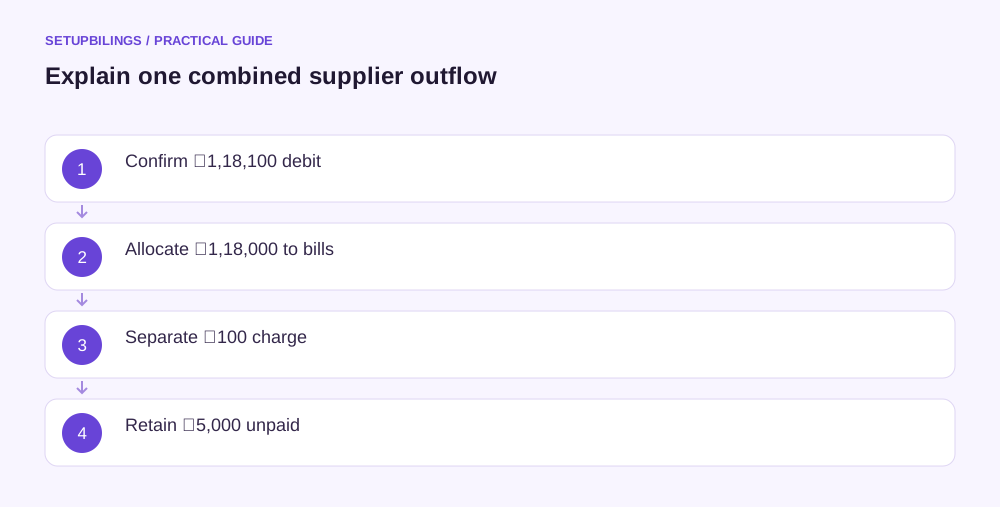
Reconcile one bank payment against several bills by identifying the payee and transfer, obtaining the remittance allocation and applying only the supported amounts to each bill's current outstanding balance. The total allocated to bills, plus any separately identified payment components, should equal the bank outflow. Retain one clear link to the original bank movement.
A single transfer does not require a single expense category. It may settle purchases already recorded across several supplier invoices. Creating a new expense equal to the transfer can duplicate those costs and leave the original bills showing unpaid.
Establish the supplier and transfer evidence
Consider an illustrative Faridabad fabrication business paying a steel supplier. Accounts obtains the bank advice, supplier account details, payment approval and the list of invoices intended for settlement. It checks that the bank debit is completed, not merely an approved instruction.
Use reference, amount, date and beneficiary evidence together. RBI's NEFT guidance identifies these details as useful for tracing a transfer. If the narration is abbreviated, obtain more detail rather than assigning the payment to whichever supplier has a similar name.
ICAI's bank-reconciliation material explains the need to match bank movements with the books. The additional allocation schedule explains which liabilities the matched payment actually settles.
Use current outstanding amounts
The supplier may already have received part payments or issued credit notes. Start with the bill balance after those supported adjustments, not only its original face value. Otherwise, the same credit can be applied twice.
Check disputed and not-yet-approved invoices separately. A payment instruction should say whether it covers them or leaves them open. Do not automatically allocate every transfer to the oldest bill if the remittance specifies a different purpose.
Obtain agreement or supporting evidence for a difference such as a discount or deduction. A short payment is not, by itself, a supplier-approved reduction in the obligation.
Build a bill-by-bill bridge
The fabrication business makes this illustrative allocation:
| Supplier bill | Outstanding before payment | Amount allocated | Remaining |
|---|---|---|---|
| S-101 | ₹48,000 | ₹48,000 | Nil |
| S-108 | ₹35,000 | ₹35,000 | Nil |
| S-112 | ₹35,000 | ₹35,000 | Nil |
| S-119 | ₹5,000 | Nil | ₹5,000 |
| Total | ₹1,23,000 | ₹1,18,000 | ₹5,000 |
The remittance identifies the first three bills, so ₹1,18,000 settles them and S-119 remains open. The total supplier liability falls by ₹1,18,000, not the full ₹1,23,000 outstanding before payment.
Do not close S-119 merely because the supplier account received a large transfer. The invoice-level result matters for later statements, reminders and dispute resolution.
Separate a genuine bank charge
Assume the bank advice shows a ₹1,18,100 total debit comprising ₹1,18,000 sent to the supplier and a ₹100 bank charge. Under this example's simplified facts, the bank outflow is explained by the supplier settlement plus the supported charge.
The accounting effect reduces the supplier balance by ₹1,18,000 and records the appropriate charge treatment for ₹100, with ₹1,18,100 leaving the bank ledger. Establish any relevant tax detail from the actual documentation rather than assuming a universal fee split.
Some banks show the transfer and charge as separate statement rows. If so, reconcile those actual rows separately instead of forcing them into one artificial bank movement. The objective is a complete bridge, not a predetermined display format.
Match existing postings before creating new ones
If accounts already recorded a payment voucher for ₹1,18,000, match the bank transfer to it and add only genuinely missing supported components. Do not create another supplier payment from the statement import.
A system may support one payment with multiple allocations, a split posting or another workflow. Use its documented process without assuming any unverified feature. The evidence should still connect the bank outflow, payment record and three settled bills.
If three separate book payment entries already represent the one bank transfer, retain a grouped match or other supported mapping. The sum must agree without duplicating the bank credit in the accounting ledger.
Handle residuals without disguising them
If the supplier confirms that ₹10,000 is an advance for a later order, record that component appropriately rather than applying it to unrelated existing bills. If the amount cannot yet be allocated, retain it as an identifiable supplier payment or temporary item under the business's accounting process.
For withholding or contractual deductions, obtain the actual basis and documentation. The difference may need a separate payable, certificate or adjustment; it should not automatically become a bank fee or discount.
Where the business accidentally paid too much, keep the recoverable amount or agreed future adjustment visible. Do not manufacture an extra bill to absorb the difference.
Review the allocation date and period
A transfer can settle bills from different months without changing when those purchases were originally recognised. Keep the payment date separate from invoice dates. The supplier account should show the settlement clearly, while the expense or asset records retain their appropriate transaction periods. Reallocating a payment should not silently recreate or move the original purchase.
Close the bank and supplier checks together
Confirm the bank outflow, the total allocation and the supplier's remaining ₹5,000 balance. Send or retain the remittance advice and compare with the supplier statement when available. Investigate any disagreement at invoice level.
Keep payment reference, settled bills, fee evidence and approval linked for later review. One combined bank payment is fully reconciled when both questions are answered: why that amount left the bank and exactly which obligations it reduced. That prevents a correct bank balance from hiding incorrect supplier balances or duplicated expenses.