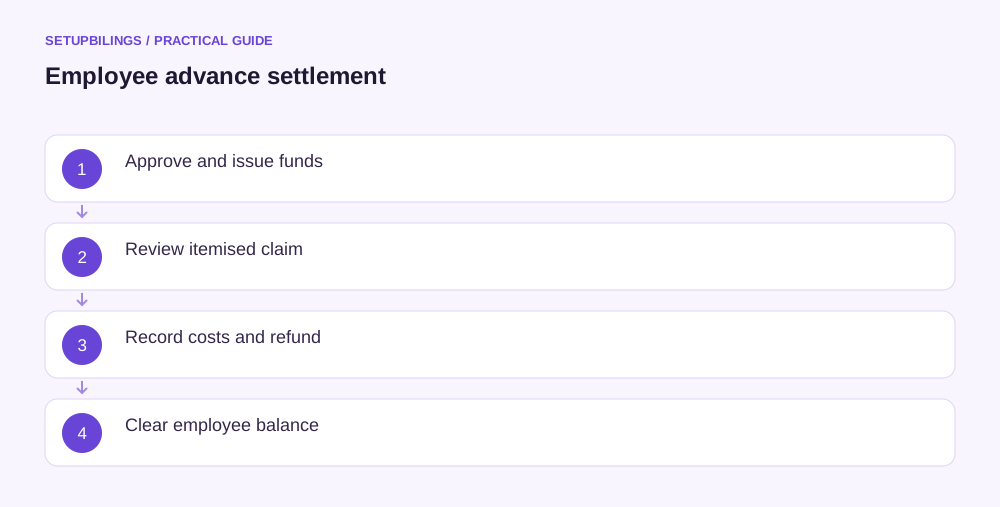
Record an employee advance as a recoverable asset until the employee provides an approved expense settlement or returns the money. Debit Employee advances and credit bank or cash when funds are issued. On settlement, debit the supported business costs and any returned money, and credit the employee’s advance balance.
Define the purpose before paying
An advance may fund travel, local purchases or another business task. Specify the employee, purpose, amount, approval and expected settlement date. A salary advance is a different arrangement from a travel advance and should be tracked accordingly.
The employee’s receipt of money does not prove an expense has been incurred. A ₹20,000 travel advance can still be largely unused when the month closes. Expensing the full payment immediately hides what remains recoverable.
Use employee-specific records under the advance control account. If one employee holds money for two trips, retain separate references so the first trip can be settled without losing the second advance.
Illustrative advance and settlement
A Madurai business transfers ₹15,000 to an employee for a supplier visit. After returning, the employee submits approved business expenses of ₹13,600 and refunds unused money of ₹1,400 into the business bank. Assume the cost amounts below exclude any separately recoverable tax.
| Event | Account | Debit ₹ | Credit ₹ |
|---|---|---|---|
| Advance paid | Employee advances | 15,000 | — |
| Advance paid | Bank | — | 15,000 |
| Settlement | Travel and visit expenses | 13,600 | — |
| Settlement | Bank | 1,400 | — |
| Settlement | Employee advances | — | 15,000 |
The advance closes because the approved costs and returned cash total the original amount. Only ₹13,600 becomes expense under the stated assumptions. The bank shows the original transfer and the later refund as separate actual movements.
In practice, split the ₹13,600 between relevant expense accounts where useful, such as travel, lodging and local transport. Preserve the itemised claim rather than relying only on a single summary total.
When the employee spends more
Suppose another illustrative ₹15,000 advance supports approved costs of ₹16,200. Debit the relevant expenses ₹16,200, credit Employee advances ₹15,000 and credit Employee reimbursement payable ₹1,200.
The employee is now owed ₹1,200. Paying that balance debits the reimbursement payable and credits Bank. Debiting expense again on reimbursement would double-count the additional cost.
An employee-advance ledger can temporarily show a credit under some system designs, but a clear payable classification helps reviewers distinguish employees holding company money from employees awaiting reimbursement.
Review the claim, not just the arithmetic
Check dates, business purpose, attendees where relevant, original invoices and policy approvals. Remove duplicate receipts and personal items before recognising costs. A claim that adds up to exactly the advance amount can still be unsupported.
If an item is rejected, the corresponding amount generally remains due from the employee unless another authorised treatment applies. Do not clear the advance by putting rejected spending into miscellaneous expenses merely because the trip has ended.
For lost documents, follow a documented exception process and record the evidence available. Approval of an exception should identify what was accepted and why; it does not automatically establish eligibility for tax credit.
GST documents require their own assessment
A business expense may be genuine even when input GST is unavailable. Review the actual invoice, recipient details, business use and restrictions under the CGST Act before separating tax from the cost.
For example, a hotel bill in the employee’s personal name or a restricted category of expenditure may need a different credit conclusion from an invoice correctly addressed to the business. Do not infer credit simply because the employee has supplied a payment screenshot.
Where eligible tax is separately recognised, debit the relevant input-tax account and the net expense amounts, with the total credit still clearing the supported employee balance.
Payroll recovery is a settlement route
If the employee is authorised to repay an unused ₹2,000 advance through payroll, the payroll settlement should credit Employee advances ₹2,000 and reduce the net amount payable to the employee by that amount.
That recovery is not new income and should not reduce salary expense merely to make the net bank payment smaller. Keep the employee’s consent or other valid authority and the payroll reference with the advance record.
Check applicable employment requirements and company policy for the actual recovery arrangement. The bookkeeping entry documents the recovery; it does not independently authorise a deduction.
Prevent old advances from disappearing
Maintain an ageing schedule with employee, purpose, issue date, due date, submitted claims, refunds and open amount. Follow up overdue items before issuing unrelated new advances where the business’s policy requires it.
When an employee leaves, reconcile the advance with approved final claims and the supported final settlement. Do not transfer the balance to a new employee because that person took over the role.
Advances used to buy equipment
An employee may use an advance to acquire a business asset rather than incur travel expense. Suppose a supported ₹12,000 purchase is for equipment qualifying for recognition under the business’s policy. Debit the appropriate equipment account, with any justified tax split, and credit Employee advances for the settled amount.
The settlement method does not determine whether the item is an asset or expense. Obtain the supplier invoice, identify the equipment and update the relevant asset records. Otherwise, a correctly cleared employee balance can still leave the business’s equipment and future depreciation records incomplete.
AS 1’s accrual principle helps distinguish costs incurred from money merely advanced. The practical control is to preserve that distinction until every rupee has either funded an approved business item or been returned through a documented settlement.