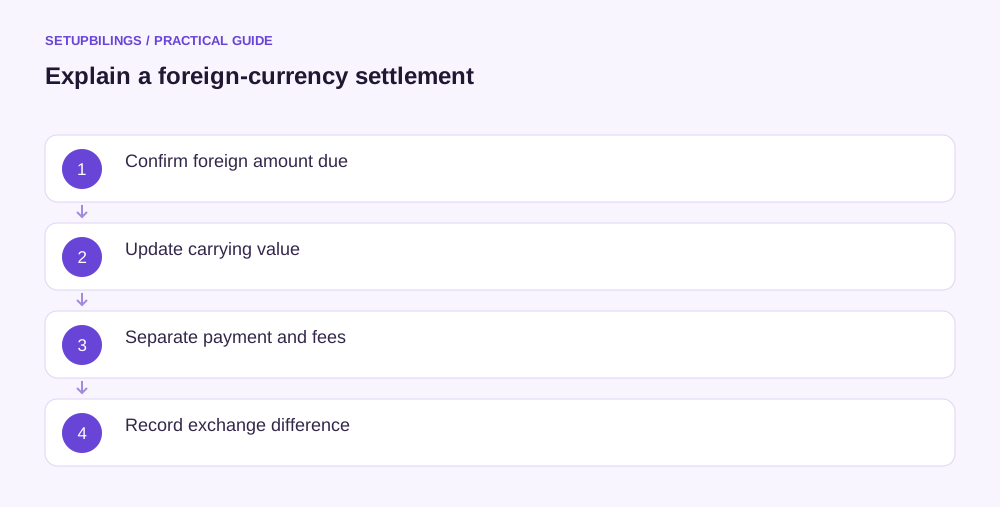
When a foreign-currency payable is settled, compare the supported rupee carrying amount of the liability with the rupee amount paid for that currency. Record the resulting exchange difference separately from the original purchase and from bank fees. Preserve the foreign-currency quantity throughout the trail so exchange movements do not become unexplained supplier balances.
Identify the currency obligation first
A supplier invoice may be denominated in US dollars, euros or another currency, while the business reports in Indian rupees. Record both the foreign amount and its rupee translation using the applicable accounting policy.
ICAI AS 11 addresses initial recognition using the transaction-date exchange rate and subsequent treatment of foreign-currency monetary items. It also addresses exchange differences, with specific matters and exceptions requiring separate attention. The example below concerns an ordinary short-term trade payable.
Do not use the eventual bank debit to rewrite the original purchase without analysis. Changes in exchange rates after recognition generally represent another event from acquiring the goods or service.
Illustrative invoice and later settlement
A Pune importer recognises a supported supplier payable of USD 2,000 when the illustrative accounting exchange rate is ₹83 per dollar. The initial rupee liability is ₹1,66,000. Assume relevant import taxes and other acquisition costs are recorded separately.
Later, the business pays USD 2,000 at an illustrative conversion cost of ₹84.50 per dollar, excluding a separately charged bank fee. The rupee payment for the currency is ₹1,69,000.
| Account | Debit ₹ | Credit ₹ |
|---|---|---|
| Supplier payable | 1,66,000 | — |
| Exchange loss | 3,000 | — |
| Bank | — | 1,69,000 |
| Total | 1,69,000 | 1,69,000 |
The supplier’s USD 2,000 claim is fully settled. The ₹3,000 difference explains the higher rupee outflow. It should not remain as an unpaid supplier balance merely because the original rupee entry was smaller.
The rates are arithmetic assumptions, not current market rates or a recommendation about which provider to use.
A stronger rupee can produce a gain
If the same USD 2,000 liability is settled at ₹82 per dollar, the currency payment is ₹1,64,000. Debit Supplier payable ₹1,66,000, credit Bank ₹1,64,000 and credit Exchange gain ₹2,000, assuming no intervening remeasurement.
The gain relates to settling the same foreign obligation with fewer rupees. It is not a supplier discount unless the supplier actually reduced the foreign amount owed.
If the invoice itself is amended, separate that price or quantity adjustment from the exchange movement. Both can occur near settlement and should not be merged without evidence.
Reporting-date remeasurement changes the carrying amount
Suppose the USD 2,000 remains unpaid at a reporting date and its supported closing-rate value is ₹1,68,000. Under the applicable AS 11 monetary-item requirements, the ordinary payable would need the relevant remeasurement, with the resulting treatment assessed accordingly.
If ₹2,000 of exchange loss has already increased the liability from ₹1,66,000 to ₹1,68,000, a later ₹1,69,000 payment produces only an additional ₹1,000 settlement difference. Recording ₹3,000 again would duplicate the earlier recognised movement.
Maintain a bridge from original translation to closing remeasurement and final settlement. That bridge is particularly useful when payments cross financial years.
Separate bank charges and conversion components
A remittance may include a transfer fee, correspondent-bank charge and tax on a service. Obtain the advice explaining each component. Do not classify the entire excess over the original invoice as exchange loss.
For an illustrative separate ₹1,180 fee, record the supported fee and any eligible tax split through the appropriate accounts. The foreign payable should still clear according to the amount actually settled with the supplier.
Where the supplier receives less because charges were deducted from the remittance, confirm whether the original obligation is fully discharged. A bank transfer instruction is not always proof that the supplier received the full invoiced currency amount.
Part payments need a consistent allocation
For a partial foreign payment, identify the foreign units settled and the corresponding rupee carrying amount. Leave the remaining foreign amount visible for later remeasurement and collection or payment.
Do not clear a rupee amount that happens to match the bank debit while leaving an incorrect foreign balance. Both currency and rupee records must reconcile.
Keep settlement references, invoice allocations and rate evidence together. Multiple invoices in the same currency can otherwise acquire incorrect exchange gains or losses through arbitrary allocation.
Check special arrangements separately
Foreign-currency advances, forward contracts, qualifying borrowing costs and long-term arrangements may need additional analysis. The ordinary trade-payable example should not be treated as a universal rule for those cases.
Tax, import valuation and financial-reporting rates can also serve different purposes. A customs document’s exchange rate is not automatically the correct rate for every book entry.
Supplier credits need foreign-currency detail too
A supplier credit note may reduce the foreign amount owed before settlement. Record the supported credit and its relevant translation first, then calculate the exchange difference on the remaining monetary balance.
If USD 200 is validly credited against a USD 2,000 invoice, the payment may settle only USD 1,800. Treating the smaller rupee payment entirely as an exchange gain would hide the purchase adjustment. Keep the foreign units and rupee effects of the credit distinct so the later payment clears the correct remaining obligation.
The final payment record should explain the original foreign obligation, its latest supported rupee carrying value, the bank settlement and separately identified charges. That makes the exchange difference a clear calculated result rather than a residual balancing amount.