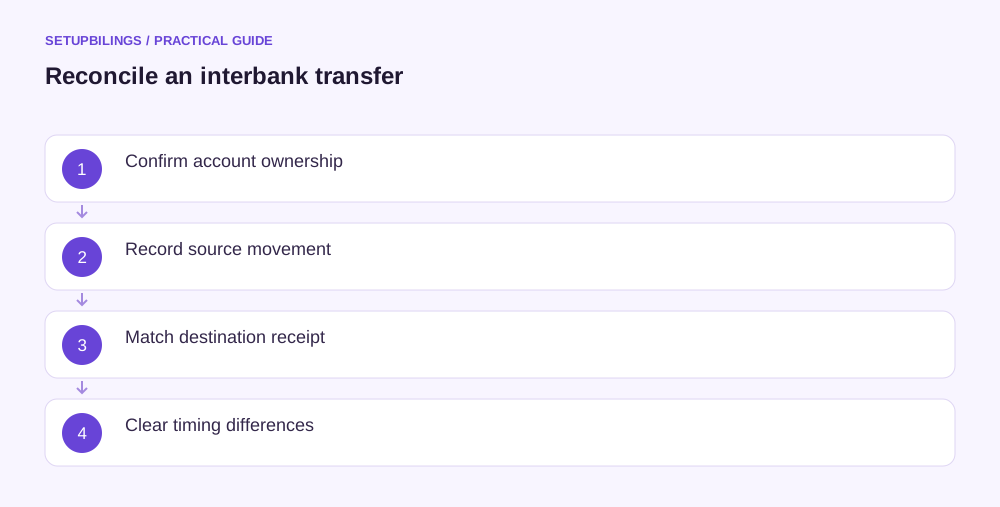
For a transfer between two bank accounts belonging to the same business, debit the receiving bank and credit the sending bank. The transfer changes where business money is held; it does not create sales, owner capital or an operating expense. Record any bank fee separately from the transferred principal.
Confirm both accounts belong to the same entity
Businesses often use one account for collections and another for payments. Transfers between them are internal movements. A transfer to a proprietor’s personal account, another company or a partner’s account is a different event requiring its own classification.
Check the account holder and purpose before choosing a contra or transfer voucher. Similar account names or shared ownership do not establish that both balances belong to the same reporting entity.
Keep a stable ledger for each bank account. Combining accounts under one “bank” code makes it harder to explain where funds sit and can hide reconciliation differences between individual statements.
Illustrative same-day transfer
A Guwahati business transfers ₹75,000 from its collection account at Bank A to its payment account at Bank B. Both statements show the completed movement on the same day.
| Account | Debit ₹ | Credit ₹ |
|---|---|---|
| Bank B: payment account | 75,000 | — |
| Bank A: collection account | — | 75,000 |
| Total | 75,000 | 75,000 |
Total business bank money is unchanged before fees. Bank A decreases while Bank B increases. Crediting sales for the Bank B receipt would inflate revenue and leave the Bank A transfer unexplained.
Use the transfer reference in both bank reconciliations. The voucher date should reflect the supported transaction and accounting policy, with any statement timing difference clearly identified.
Use clearing when settlement crosses periods
Suppose Bank A debits ₹75,000 on 31 March but Bank B receives it on 1 April. A controlled transfer-clearing account can show the money in transit rather than prematurely claiming it appeared in Bank B.
On the supported dispatch, debit Interbank transfer clearing ₹75,000 and credit Bank A ₹75,000. When receipt is confirmed, debit Bank B ₹75,000 and credit Transfer clearing ₹75,000.
The clearing balance should be temporary and supported by the transfer instruction and subsequent receipt. It is not an expense account or a place to park unexplained differences indefinitely.
Match the complete transfer pair
A bank-feed import may show an outgoing payment and an incoming receipt separately. Link both sides to the same internal transfer instead of posting two unrelated vouchers with different counterpart accounts.
Before entering a manual transfer, search for an existing imported record. Otherwise, the same ₹75,000 can be moved twice in the books while only one actual transfer occurred.
Match amount, date, reference and account pair. Two transfers of the same amount on the same day require enough reference detail to distinguish them; amount alone is not a dependable unique identifier.
Fees reduce total money separately
Assume the sending bank charges an illustrative ₹118 in addition to the ₹75,000 transfer. Record the ₹75,000 principal as the internal movement and record the supported ₹118 fee separately, with any recoverable tax split justified by the actual document.
The total Bank A reduction may therefore be ₹75,118 while Bank B receives ₹75,000. That difference does not mean the receiving bank is short or that sales should be reduced.
If fees are deducted from the transferred amount instead, obtain the advice explaining the net receipt. The clearing schedule should show how principal, charges and any remaining amount reconcile.
Failed transfers and reversals
A payment instruction can fail before funds leave, or funds can be debited and later returned. Record actual supported movements and their reversals rather than treating the instruction as conclusive proof of settlement.
Where Bank A returns the money before Bank B receives it, clear the transfer-in-transit balance through the supported reversal. Do not leave an artificial Bank B debit that cannot be matched to a statement.
Any retained failure charge is a separate cost. The return of principal does not automatically reverse every associated fee unless the bank actually refunds it.
Foreign-currency accounts need another layer
A transfer between accounts in different currencies can involve exchange translation, conversion spreads and bank charges. The simple equal-rupee entry is not enough to explain all those components.
Use the actual foreign-currency amounts, supported rates and applicable accounting requirements. Keep transfer principal distinct from the exchange difference and service fee so the receiving balance can be reconciled in both currencies.
Do not force the destination ledger to the source rupee amount if the supported conversion and accounting measurement require another result.
Review internal transfers at closing
List open clearing items with sending account, receiving account, reference, dispatch date and expected receipt. Investigate old balances and obtain bank confirmation where needed.
Compare transfer totals across accounts and ensure internal movements are not included in sales or vendor-payment analysis. A business can have large gross bank turnover from internal transfers without earning additional revenue.
Separate transfers from cash-pooling arrangements
A movement to another account can be part of a group cash-pooling arrangement rather than a transfer between the same entity’s ordinary bank balances. Read the arrangement and identify whether the business has a bank asset, intercompany balance or another supported right afterward.
Do not select the receiving account merely from a familiar group name. The simple contra entry depends on both balances genuinely belonging within the same entity’s money records.
The completed record should show one supported movement out and one supported movement in, with fees and timing differences explained. That gives each bank reconciliation a clear counterpart and preserves a reliable view of available business funds.