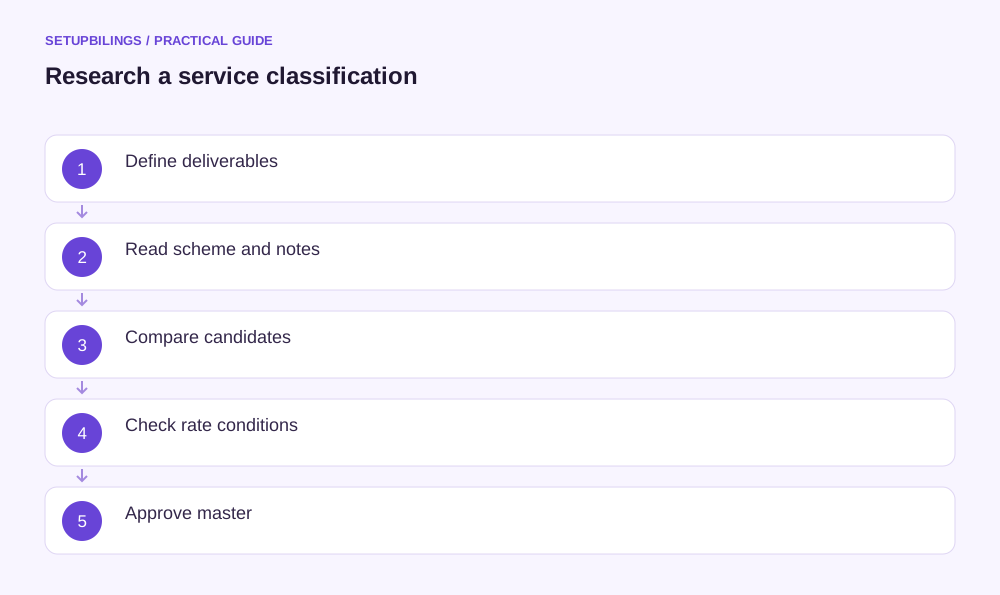
Research a service's SAC by describing what the customer is actually buying, then comparing that activity with the official Scheme of Classification of Services and its explanatory notes. A broad description such as “consultancy” or “support” is rarely enough for a difficult case. The GST Council's official service resources identify both the scheme and explanatory notes. Treat classification, rate, exemption, reverse charge and place of supply as connected but separate questions.
Begin with the contract and deliverables
Read the scope of work, proposal, customer acceptance criteria and payment milestones. Identify the work performed, the output delivered and any rights transferred. A provider described commercially as an agency may supply creative production, placement, advisory work or several distinct activities. Its business name does not classify each transaction.
Write a plain-English activity statement before researching codes. For example: “Prepare monthly management reports from customer-supplied accounting data” is more useful than “professional charges.” Include who performs the work, what information or equipment is used and whether the customer receives a report, access, a licence, maintenance or a completed physical result.
Break complex scopes into factual components
List material components without prematurely deciding that each is a separate supply. A contract may include advice, implementation, training and support. The commercial and GST analysis must establish whether these are independent supplies, a naturally bundled arrangement or another structure. Merely placing each activity on a separate invoice line does not answer that question.
Capture optional components and separate pricing. If a customer can purchase training without implementation, record that fact. If the supplier must provide training to make the main service usable, record that too. These facts help the reviewer consider classification and any composite-supply question without relying on labels chosen by the sales team.
Read inclusions and exclusions together
Compare candidate service entries with their explanatory notes. An entry that appears to describe part of the work may expressly exclude another activity. Keep a note of adjacent classifications considered and the feature that supports the selected one. Avoid searching only for the rate you expect to charge.
| Scope evidence | Why it helps |
|---|---|
| Signed statement of work | Defines what the customer purchases |
| Sample deliverable | Shows the actual output |
| Rights and licence terms | Identifies access or intellectual-property elements |
| Optional-service price list | Helps distinguish separately available components |
| Performance and acceptance clauses | Shows how completion is measured |
A short factual file is often more valuable than a long list of search results with no connection to the service.
Illustrative analytics engagement
Suppose an MSME agrees to pay ₹90,000 for an analytics project, including a dashboard, an explanatory report and two staff workshops. Before selecting a SAC, ask whether the supplier develops software, provides analysis, licences a platform or supplies a broader advisory engagement. The answer depends on the contract and actual deliverables, not on the word “dashboard.”
If a confirmed aggregate GST rate of 18% applies after review, tax would be ₹16,200 and total consideration ₹1,06,200, assuming an exclusive price and no other valuation issue. That calculation illustrates billing impact only. It does not establish the classification or show that every analytics, software or training transaction carries that rate.
Verify the rate and its conditions separately
Once the classification is proposed, examine the applicable service rate notification and amendments for the supply date. Check recipient conditions, project type, exemptions and any restrictions associated with the entry. A six-digit service code alone may not tell you every condition that affects the invoice.
Review reverse charge independently where relevant. The fact that a service category sometimes falls under reverse charge does not mean every provider and recipient combination does. Likewise, place of supply may follow a specific rule even where classification is straightforward. Store these decisions in distinct master fields rather than compressing them into one “SAC rate” text box.
Give the item master a usable description
Use the approved activity description in the master and a customer-readable version on invoices. Include service period, contract reference or milestone where useful. “Monthly reporting service, September, agreement AR-09” is easier to trace than a repeated line saying “charges.” Avoid exposing unnecessary internal work notes in the customer copy.
Create separate items where the business actually supplies different services, rather than allowing staff to change a single generic item's code for each bill. Retain the research basis and effective dates. This makes a later review possible without reconstructing months of contracts from email.
Ask delivery staff to check the first completed engagement against the approved description. Sales proposals can describe a broader outcome than the work ultimately performed. If the actual deliverable differs materially, update the factual file and reopen the classification review before the first invoice becomes the model for every later contract.
Revisit the decision when the service changes
A recurring engagement can evolve. Advisory work may expand into operation of a process, a licence can replace a custom development project, or onsite work may become central to the scope. Review material changes before copying the previous month's classification.
Complete the research with a dated decision note covering facts, candidate entries, explanatory notes, selected SAC and separate rate analysis. List any assumptions that the delivery team must preserve. A useful SAC decision is one that billing and service staff can apply consistently because it describes the actual activity, rather than a code selected once and forgotten.