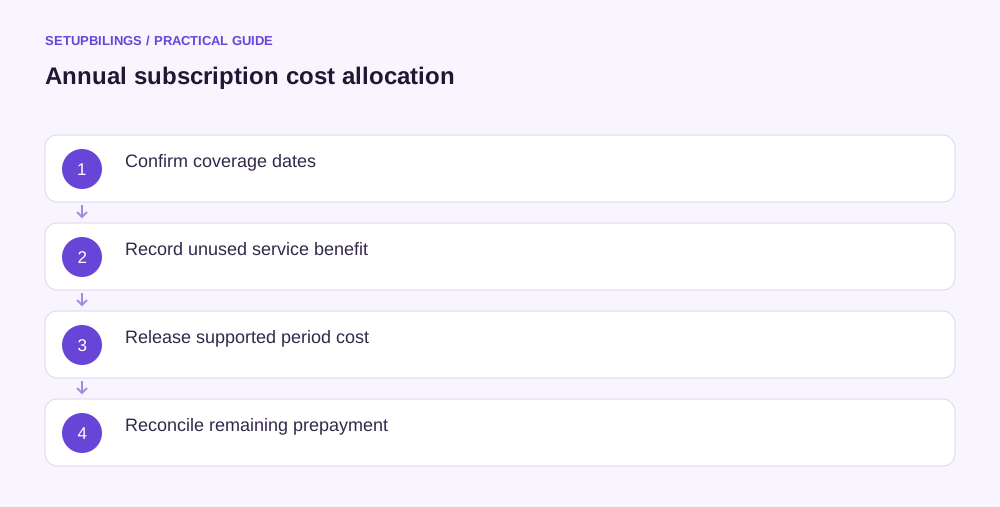
For an annual subscription that provides service over twelve months, recognise the unused benefit as a prepaid expense and release it to expense over the service period on a supported basis. The payment date does not necessarily determine when the whole cost belongs in profit. Start by confirming exactly what access or service the contract provides.
Read the service dates and components
An annual invoice might cover software access, support, implementation and user training. Those components do not necessarily share the same timing or accounting treatment. Separate them where the contract and amounts justify doing so.
This article illustrates a straightforward hosted subscription, not the acquisition of a perpetual software licence or another asset requiring different analysis. Review the applicable accounting policy before assuming every payment containing the word “software” is a prepaid service.
ICAI AS 1’s accrual principle supports recognising costs in the periods to which they relate. For a uniform subscription service, equal monthly allocation may be reasonable, but the actual pattern of benefit should guide the method.
Illustrative annual payment
A Hyderabad design studio pays ₹24,000 on 1 January for service from 1 January to 31 December. Assume the whole amount is service cost and tax is excluded from this simplified illustration.
| Event | Account | Debit ₹ | Credit ₹ |
|---|---|---|---|
| Annual payment | Prepaid subscription | 24,000 | — |
| Annual payment | Bank | — | 24,000 |
| Monthly release | Subscription expense | 2,000 | — |
| Monthly release | Prepaid subscription | — | 2,000 |
The monthly release is ₹24,000 divided by twelve months. After January, the prepaid balance is ₹22,000. After March, three months’ expense totals ₹6,000 and the unused balance is ₹18,000.
At an illustrative 31 March reporting date, ₹18,000 represents the remaining April-to-December service under the stated assumptions. The bank outflow remains ₹24,000; spreading the cost does not change when cash was paid.
If the invoice was initially expensed
A business may initially debit the whole annual payment to Subscription expense. At 31 March in the example, it can reclassify the unused ₹18,000 by debiting Prepaid subscription and crediting Subscription expense ₹18,000.
That produces the same ₹6,000 expense and ₹18,000 prepaid balance as a correctly maintained monthly schedule. Do not make that period-end reclassification if monthly releases already left the proper prepaid amount; doing both would overstate the asset.
Choose a consistent workflow and document it. The objective is the correct closing cost and unused benefit, not a particular number of journals.
Mid-month starts need a deliberate basis
If service starts on 16 January, twelve equal calendar-month postings may not reflect the contract period accurately at each close. A daily allocation or a consistent, supportable partial-month convention may be more appropriate, considering materiality and the business’s reporting needs.
Keep the start date, end date and allocation formula in the schedule. Avoid counting the payment month as a full month merely because the bank transfer happened before month end.
For usage-based plans, a fixed straight-line release may not explain the cost. Distinguish prepaid credits consumed by actual use from an annual right to continuous access. Read the provider’s consumption and expiry terms before deciding how to release the balance.
Renewals should not overwrite the old contract
A renewal may be paid before the current service expires. Record the new period separately so its cost is not released before the renewal coverage begins. The prepaid schedule can contain two contract rows for the same provider.
For example, paying next year’s ₹30,000 renewal in November does not mean November should bear both the current monthly cost and the full renewal. Track the future coverage alongside the remaining current contract.
Verify auto-renewals and card receipts against provider invoices. Repeated card deductions can be monthly add-ons, user charges or a second subscription, rather than the expected annual renewal.
Cancellations and refunds change the unused benefit
Suppose the studio cancels after six months and the provider agrees to refund the remaining ₹12,000. Establish the enforceable refund and record the resulting receivable or bank receipt against the prepaid balance as appropriate.
If the unused amount is not refundable and no future service benefit remains, assess whether the balance should be expensed. Do not keep it as a prepaid asset simply to preserve the original twelve-month schedule.
Where a cancellation fee is retained, identify that amount separately. The actual settlement may contain a refund, a fee and continued access until a specified date, each requiring clear treatment.
Tax and foreign-currency invoices need separate review
The accounting allocation of service cost does not by itself determine GST credit timing, reverse charge or withholding obligations. Review the actual supplier, invoice and transaction facts under the applicable rules.
If eligible tax is recoverable, distinguish it from the cost being spread. If tax is not recoverable, determine whether it forms part of that service cost. Foreign-currency contracts also need a supported translation policy; do not change every monthly release merely to match today’s exchange rate without assessing the relevant rules.
Close the schedule to the ledger
For each contract, show opening prepaid amount, additions, expense releases, refunds or other adjustments and closing balance. Reconcile the total to the general ledger and review expired contracts.
Control rounding in the release schedule
Some annual amounts do not divide into twelve equal paise amounts. Preserve the original total and use a documented final-period adjustment for the small rounding balance. The schedule’s cumulative releases should equal the supported cost by the end of coverage.
Do not leave recurring one-rupee balances on expired contracts year after year, or write off an unexplained larger difference as rounding without investigating it.
The subscription entry is reliable when the expense reflects service already received and the prepaid balance represents a real remaining benefit. A clear schedule makes that result repeatable every month.