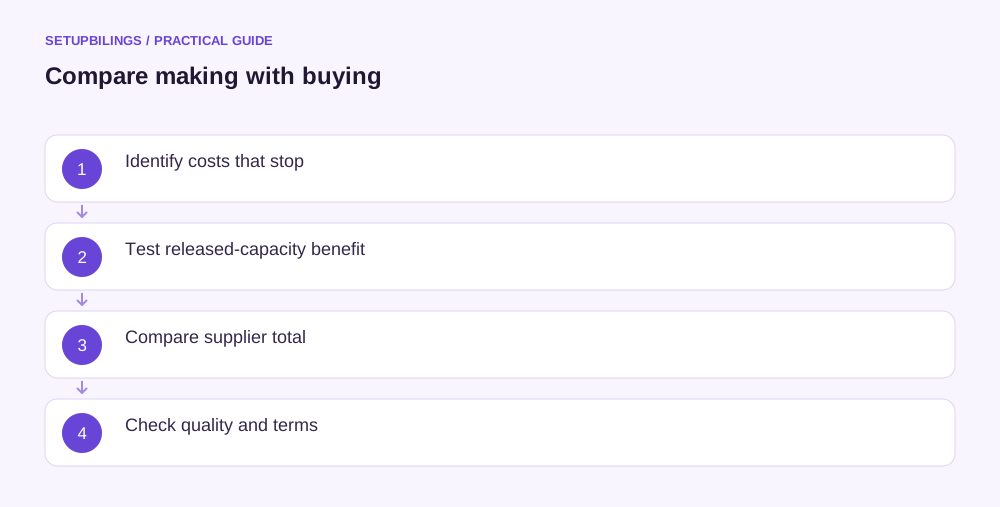
A make-or-buy analysis should compare future costs that change between internal production and purchasing from a supplier. Include avoidable internal costs, relevant purchasing and quality costs, and the value of any alternative use of released capacity. Exclude sunk costs and common costs that remain whichever option is chosen.
A supplier quote below your allocated full cost does not automatically mean outsourcing saves money. Some allocated overhead may continue after production stops. Conversely, internal production can appear cheap while consuming machine time that could earn more contribution elsewhere.
Define an equivalent requirement
Consider an illustrative Ludhiana manufacturer needing 10,000 specialised pins over the next quarter. The supplier quote must match drawing revision, material, tolerances, inspection, packaging, delivery schedule and rejection responsibility. A cheaper quote for a different specification is not a meaningful alternative.
Set the decision period. A three-month outsourcing trial differs from permanently closing a production cell. Labour contracts, equipment leases and support staffing may be unavoidable in the short term but changeable over a longer horizon.
ICAI's marginal costing material presents make-or-buy as a managerial choice between alternatives. The essential discipline is relevance: identify which future amounts differ because of the decision, rather than treating every allocated cost as a cash saving.
Build the relevant-cost comparison
The pins have the following illustrative internal costs:
| Internal cost for 10,000 pins | Total | Avoidable if buying? |
|---|---|---|
| Materials | ₹2,00,000 | Yes |
| Piece-related labour | ₹1,00,000 | Yes, under this example's staffing facts |
| Variable machine costs | ₹50,000 | Yes |
| Dedicated temporary supervision | ₹30,000 | Yes |
| Allocated shared factory overhead | ₹1,20,000 | No, continues |
| Reported full cost | ₹5,00,000 | Relevant avoidable portion: ₹3,80,000 |
A supplier offers the pins at ₹42 each, or ₹4,20,000, including delivery. Additional receiving inspection is estimated at ₹10,000. Relevant buying cost is ₹4,30,000, compared with ₹3,80,000 avoidable internal cost. With idle released capacity and no other changes, making is cheaper by ₹50,000.
Comparing the ₹4,20,000 supplier price only with ₹5,00,000 reported full cost would suggest an ₹80,000 saving that the business cannot actually realise. The continuing ₹1,20,000 shared overhead remains after outsourcing and should not disappear from the business forecast.
Add the opportunity cost of scarce capacity
Now suppose the pin machine could instead produce another confirmed order earning ₹90,000 additional contribution during the quarter. That contribution is lost if pins remain internal. Relevant economic cost of making becomes ₹3,80,000 plus ₹90,000, or ₹4,70,000.
Buying at ₹4,30,000 would then improve the result by ₹40,000, assuming the alternative order is feasible and no additional costs were omitted. The opportunity cost must be based on a real available use, not a hypothetical order that sales hopes to win.
Do not add the alternative product's revenue as opportunity cost. Use the contribution or other relevant benefit after its incremental costs. Also confirm that the same bottleneck resource is genuinely released by outsourcing.
Challenge labour and overhead assumptions
The table assumes ₹1,00,000 labour cost can be avoided. If employees remain on fixed pay and cannot be redeployed productively, that amount may not disappear during the decision period. Recalculate with the actual staffing facts.
Equipment book value is not automatically relevant to the future choice. Past acquisition expenditure is sunk. Future maintenance, rental commitments, disposal proceeds, shutdown expenditure or avoided replacement spending can matter if they differ between the alternatives.
Prepare separate short-term and longer-term views where needed. Buying may be unattractive for a quarter but sensible before the business commits to replacing worn equipment. The decision should reflect the horizon management is actually approving.
Evaluate supply and quality consequences
Test samples and confirm process capability before relying on the supplier for critical production. Include expected inspection, rejection handling, transport, minimum order quantities and the cash tied up by advance payments or buffer stock.
Consider lead time, continuity, tooling ownership, drawing confidentiality and the cost of switching back. These factors do not all fit neatly into a unit-price formula, but they can determine whether the numerical saving is usable.
Where uncertainty is material, compare a base case with a higher-rejection or delayed-delivery case. A small expected saving may not justify a change that puts a major customer delivery at risk. Use evidence and a bounded trial rather than assigning arbitrary large risk premiums.
Is buying always a permanent decision?
A limited outsourcing arrangement can provide evidence before a larger commitment. Specify the trial quantity, inspection standard, delivery windows and internal capacity to retain. Compare trial results with the original cost assumptions, including the administrative effort of managing the supplier.
The trial should also test the proposed benefit of released capacity. If no additional contribution appears because the alternative orders never materialise, the opportunity-cost case for buying may be weaker than expected. Keeping that assumption separate from the supplier's unit price makes the review fair: a good supplier cannot create the internal sales demand that management assumed would use the freed machine.
Make the decision reviewable
Document the specification, volume, horizon, avoidable cost evidence and alternative capacity use. State what must happen for the preferred option to remain better. Obtain an updated supplier quote if assumptions change before commitment.
After the trial or quarter, compare actual purchase, inspection, internal spending and released-capacity benefit with the model. A sound make-or-buy decision improves the whole business result. It is not established by a lower supplier price alone or by an internal unit cost containing overhead that the business continues to pay.
Keep a separate cash comparison when payment terms differ. An internal production schedule may require weekly material purchases, while the supplier could demand the full quarter's value in advance. The cheaper economic option can still need a financing arrangement before it becomes operationally feasible.