Prove the right to use the declared premises
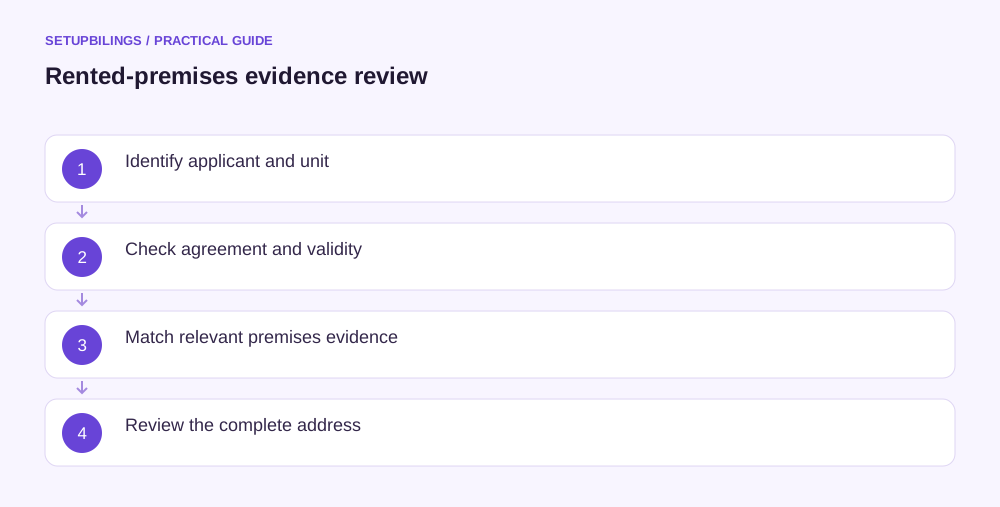
For a GST application at rented premises, the evidence should connect the applicant, the premises and a valid right to use that location. A rent receipt alone may not explain all three. Start with the actual arrangement: who rents the property, which unit is covered, when possession begins and whether the agreement remains valid.
CBIC's Instruction 03/2025-GST, dated 17 April 2025, sets out documentary guidance for rented and leased premises. It distinguishes registered and unregistered agreements and cautions against routine demands for excessive landlord documentation. Use those distinctions when building the file rather than treating a checklist circulating online as a universal legal requirement.
Read the agreement before scanning it
Confirm that the tenant name corresponds to the GST applicant. For a company or partnership, an agreement solely in an owner's personal name can require closer examination of the actual right available to the entity. Do not change the tenant field in the application merely to fit an unsuitable agreement.
Review the property description, unit or floor, address, period, parties and signatures. Check extensions or renewal documents if the original term has ended. Where only part of a building is occupied, the agreement should make that area understandable. An undifferentiated building address can leave uncertainty about which premises are actually used.
The GST document guidance does not decide every issue under stamp, registration, tenancy or local property law. An agreement accepted as GST evidence does not automatically settle its validity for every other purpose. Check the actual document and applicable requirements without inventing a uniform stamp-paper amount for all States and agreements.
Distinguish registered and unregistered agreements
The 2025 instruction explains that a registered rent or lease agreement, together with one relevant ownership-supporting document, should suffice under that route. It says that lessor identity proof should not additionally be sought in that registered agreement case. Appropriate supporting records include those in the registration document list or similar recognised ownership evidence.
For an unregistered agreement, the instruction describes the agreement, one relevant ownership-supporting document and the lessor's identity proof. That is a distinct documentary combination. It does not justify asking every applicant for the landlord's PAN, Aadhaar, photograph inside the property and multiple utility bills as a routine bundle.
Where an electricity or water connection is in the applicant tenant's name, the instruction specifically addresses accepting that evidence with the rent agreement without additional lessor documents. Check that the connection relates to the declared premises and that the applicant's name is readable. A bill for another unit cannot establish the location just because the tenant's name matches.
Make the address consistent and complete
Compare the agreement with the proposed portal fields: building number, flat or unit, floor, road, locality, city, district, State and PIN. GSTN provides both map-assisted and manual address entry. Whichever method is used, verify the actual location instead of assuming a suggested map result is correct.
Real addresses often differ in abbreviation or historic naming. Explain a material difference with relevant evidence rather than silently choosing one version. For example, an agreement may state an industrial estate plot number while a utility bill uses a service connection address. Keep the link between those descriptions clear and retain a note of the supporting record.
Illustratively, a Nagpur distributor rents the first floor of Plot 42 for ₹18,000 per month, but its draft application says “Ground Floor, Plot 24.” Uploading a perfect agreement will not fix that incorrect field. The owner should correct both the transposed plot number and floor before submission, then check the map location against the actual entrance.
Handle missing agreements truthfully
The 2025 instruction also addresses rented or leased premises where a rent or lease agreement is unavailable. It describes an affidavit explaining that position, together with prescribed evidence supporting the applicant's possession, such as an electricity bill in the applicant's name. The instruction specifies execution before the stated authorised persons on the relevant non-judicial stamp paper.
This route should not be used as permission to invent a tenancy or obscure a disputed right to occupy property. Establish the real facts first. If the arrangement is actually family permission without rent, review the consent-premises route instead. If the applicant cannot show any genuine right to use the address, creating an affidavit does not make that business location real.
Keep the original agreement or affidavit and supporting records available. Upload readable copies in the current permitted formats and sizes. Include all relevant pages, particularly the property schedule, signatures and renewal terms. Compression should not remove the very details that establish the applicant's connection with the premises.
A change in the landlord's bank account for rent collection does not necessarily change premises possession, while a move to a different floor can. Record property events separately from rent-payment administration. This helps the accounts team decide which development actually requires a GST address review instead of forwarding every landlord message as an amendment request.
Review clarifications and maintain the file
If a registration clarification asks about the premises, identify the exact issue: unreadable evidence, incomplete address, ownership link or possession period. Provide a focused explanation and the relevant record through the prescribed portal process. Keep the notice, response and acknowledgement together rather than treating an informal phone conversation as the complete answer.
After approval, monitor lease expiry and any move to another unit. A new office or changed principal place requires a fresh registration-profile review; storing the new agreement in an accounting folder alone does not update the GST records. Good rented-premises evidence remains useful throughout the tenancy, not only on the day registration is sought.