Record a business event in the accounting books when its financial effects meet the relevant recognition and measurement requirements. A cash payment is one clear example, but unpaid purchases, depreciation and inventory losses can also require entries. Conversely, a significant meeting or a promising enquiry may matter commercially without creating an accounting transaction to recognise.
The distinction is not simply “money moved” versus “nothing happened.” Accounting considers resources, obligations, income and expenses, while operational records capture many other useful facts. Some matters require disclosure or further assessment even when no amount is recognised in the ledger.
Begin with a measurable financial effect
Consider an illustrative Ranchi commercial kitchen supplier. It pays ₹20,000 to a fabricator as an advance for work not yet performed. Cash decreases and a supplier advance or other appropriate asset is considered, subject to the arrangement and recoverability. The payment is recorded even though the eventual purchase or expense may not yet be recognised.
A week later, the supplier receives a ₹1,00,000 equipment order from a restaurant. If the agreement is still unperformed by both parties and no other recognition condition is met, the order does not automatically create sales revenue and a customer receivable. It belongs in the order book and may require other consideration under the relevant requirements.
When goods or services are actually supplied, the accounting analysis changes. The business must examine performance, transfer conditions, price and uncertainty under its applicable framework. The order, invoice, delivery and payment each document a different stage.
Recognise non-cash events where required
Suppose a warehouse leak damages stock costing ₹45,000. The business expects only ₹18,000 of net realisable value from the affected items based on condition, selling price and necessary selling costs. Under an AS 2 assessment using these simplified facts, a ₹27,000 write-down is required.
No bank payment occurs when the damage is discovered. Yet leaving inventory unchanged would overstate the recorded asset. The source evidence may include a count, photographs, inspection notes and a supported valuation calculation.
Depreciation provides another example. Equipment use gives rise to a periodic accounting charge under the relevant requirements, although the purchase may have been paid months or years earlier. The entry is supported by the asset register, useful-life assessment and calculation rather than a new supplier invoice.
Separate intention from obligation
Management may decide to refurbish a showroom for an estimated ₹3,00,000 next year. A budget records that plan for management purposes. It does not automatically create an expense and liability today. The business must establish whether a present obligation exists and which recognition requirements apply.
Likewise, deciding to hire another employee is different from receiving the employee’s services. Signing a contract may create commitments or other accounting consequences depending on its terms, but it should not be translated mechanically into the full future wage expense on the signing date.
| Business event | Likely first action |
|---|---|
| Supplier delivers accepted goods on credit | Assess purchase or asset and payable recognition |
| Customer makes an advance payment | Record receipt and assess the outstanding obligation |
| Owner considers opening another shop | Keep planning records; assess actual costs separately |
| Stock is damaged | Assess loss and closing inventory measurement |
| Business receives a legal claim | Assess obligation, probability, measurement and disclosure |
The phrase “likely first action” matters. The transaction facts and applicable standard can change the result; the table is a way to organise questions, not a universal posting instruction.
Keep important unrecorded information visible
A business can gain a valuable customer relationship or develop a strong reputation without recognising an internally generated goodwill asset. That does not mean the relationship is irrelevant. It may belong in customer concentration reports, sales planning and risk discussions.
Similarly, a large quotation pipeline can support operational forecasts but should remain distinguishable from recognised revenue and contracted receivables. Converting every expected sale into the ledger would make the accounts a record of hopes rather than completed or otherwise qualifying events.
Maintain separate operational registers for enquiries, orders, commitments and future plans. Link them to accounting records when relevant stages occur. This lets the owner use forward-looking information without confusing forecasts with financial statements.
Use a documented recognition decision
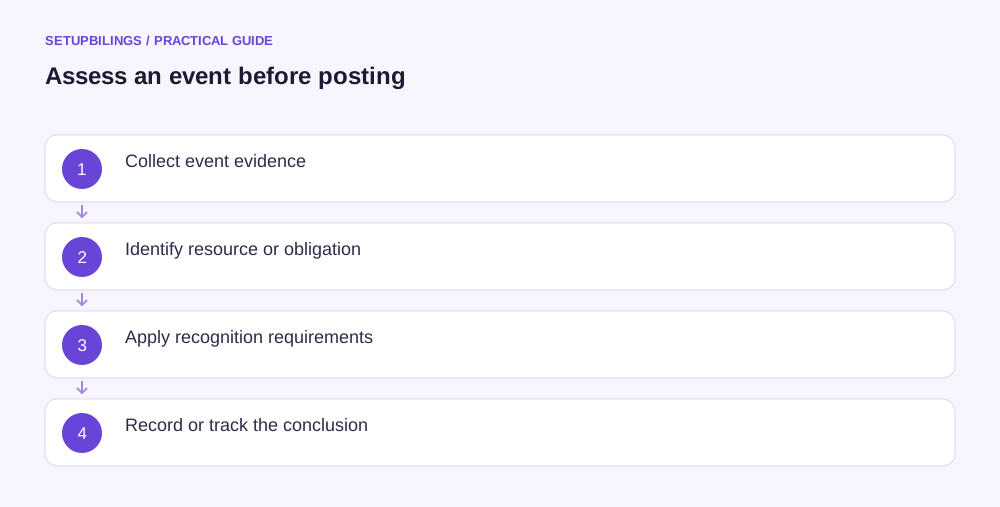
For an unusual event, write down what happened, when it happened, which entity is affected and what evidence exists. Identify any resource or obligation, the relevant measurement and the applicable recognition or disclosure requirement. Record who reviewed the conclusion.
An uncertain legal claim, for example, may need expert input. Under AS 29, provision recognition depends on a present obligation, probable outflow and reliable estimate. Other circumstances may lead to contingent liability disclosure instead. Neither automatic recognition of the demanded amount nor complete silence is a satisfactory default.
When an event cannot be measured or recognised, retain the information for later review. Circumstances can change. New evidence may make an estimate reliable or establish that an obligation no longer exists. Document the new facts and the accounting response.
Give staff a route for reporting events that may need accounting review. A warehouse employee may know about damage before finance sees any paperwork, and a project manager may know a customer has accepted work before billing occurs. A short event notification process helps capture those facts promptly. It should request evidence and dates without asking operational staff to decide the final journal entry themselves.
Accounting therefore records more than bank activity and less than every important business development. Apply recognition rules to the financial effects, keep relevant disclosures and maintain operational records for the rest. That boundary gives the owner a ledger that is supportable and a wider information system that still captures what may affect the business next.