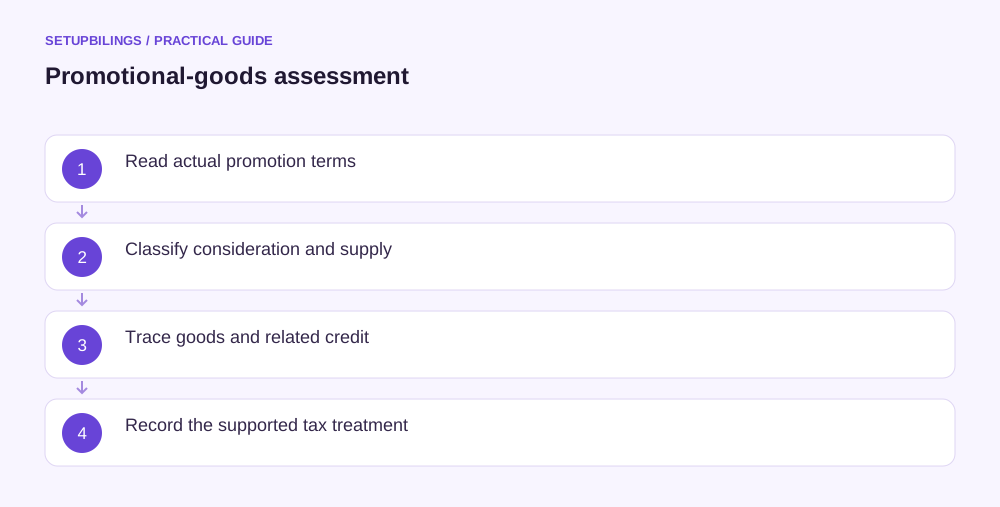
Identify whether the goods are truly given without consideration
Section 17(5)(h) restricts credit concerning goods disposed of as gifts or free samples. Begin with the actual arrangement: what goods leave the business, who receives them, whether consideration exists and whether another statutory supply rule applies. A campaign using the word free does not automatically describe a separate gift for GST purposes.
Keep the promotion terms approved before distribution and compare them with actual invoices and dispatch records. A sales team may describe a bundle differently from the contract or customer bill. The tax review should follow the transaction, not whichever advertisement headline is easiest to copy into the ledger.
Separate samples, gifts and bundled sales
A product sample sent without consideration to a prospect needs a different analysis from two goods supplied together for one agreed price. CBIC Circular 92/11/2019 discusses these distinctions, including promotional arrangements that are not simply independent free supplies. Do not apply the gift restriction mechanically to every extra item in a customer package.
For a genuine sample, retain the purpose, recipient list, quantity and distribution evidence. For a bundled sale, retain the price and supply structure and assess the applicable composite or mixed-supply treatment where relevant. A zero-valued line on an invoice does not by itself settle whether consideration supports the overall package.
Illustratively, a cosmetics business sends 200 trial packs to prospective retailers and separately sells a two-product festival pack for ₹1,000. The samples and paid pack should have different transaction records. Calling the second product free in a campaign does not necessarily make it identical to the uncompensated trial packs.
Review Schedule I situations separately
Certain supplies without consideration can fall within Schedule I. Circular 92 explains that where gift or sample distribution falls within that supply framework, the relevant credit treatment differs from the ordinary uncompensated promotional case. Establish the actual statutory conditions instead of assuming all no-charge movements are outside supply.
Document recipient relationships, business purpose and any facts relevant to the Schedule I analysis. Transfers between distinct registrations and other specified relationships should not be disguised as ordinary external marketing samples. Conversely, do not invent a taxable supply merely to avoid the credit restriction.
Keep the output-supply assessment and input-credit conclusion connected but distinct. The business needs to know both how the dispatch is documented and why the related credit is allowed or restricted. A warehouse issue note alone cannot answer the legal classification.
Trace the related input tax carefully
Identify the goods distributed and their purchase or production linkage. Check what credit was actually taken and whether it was already adjusted. Do not estimate the affected credit from the retail price of the gift or multiply the number of recipients by a standard promotional allowance without invoice support.
For manufactured promotional goods, use the production and input records needed to support the relevant amount. Circular 92 discusses related inputs, services and capital goods in the specified sample and gift context. Review the actual extent of use rather than assuming either that only the finished pack's purchase tax matters or that every marketing expense in the company must be reversed.
Separate a direct cost from common expenses requiring a different allocation analysis. A marketing department may run paid campaigns and genuine sample distribution in the same month. The review should identify which costs relate to which activity, with a supported method for genuinely shared items.
Control stock and recipient evidence
Maintain a distribution register with item, batch, quantity, recipient, purpose and dispatch reference. Reconcile it to stock issues and the approved promotion. This prevents ordinary sales being wrongly coded as samples and makes it easier to identify goods lost or used personally rather than delivered under the campaign.
Record returns or unused packs. A sample sent back unopened and later sold should remain traceable through the stock system, with any credit treatment reviewed from the actual history. Do not automatically reclaim a previous adjustment merely because the campaign ended; establish what happened to the affected goods and the legal basis for any further action.
Employee gifts need a separate review of the actual arrangement and applicable provisions. A staff-distribution list should not be treated as a customer sample programme simply because both use the marketing budget. Keep employment, recipient and supply facts visible instead of forcing all complimentary goods into one code.
Ask marketing to retain the actual customer terms alongside the final promotional artwork. An advertisement can abbreviate a price arrangement, while the order terms explain what the customer pays for. If those records disagree, resolve the commercial facts before deciding credit treatment. The tax file should not rely solely on an internal campaign name such as free launch pack.
Record the outcome before filing
Use separate statuses for genuine restricted gifts or samples, qualifying paid promotional supplies, specified no-consideration supplies and unresolved cases. Keep the relevant contract, circular analysis and amount calculation with each material decision. A simple promotion code should not override a documented exception or an unresolved fact.
Complete the applicable reversal or other reporting and reconcile the entry to the books. Record the period and underlying goods so the same campaign is not adjusted again during year-end review. A ledger expense labelled free samples is not proof that the corresponding credit issue has already been addressed.
The strongest promotion review explains the commercial arrangement first and calculates credit second. That sequence avoids both unsupported claims on genuine gifts and unnecessary denial where a paid bundle or specified statutory supply has different treatment.
Sources and references
- CBIC: current CGST section 17, apportionment and blocked credits
- CBIC Circular 92/11/2019-GST: gifts, samples and promotional schemes
- CBIC: Central Goods and Services Tax Act, consolidated through August 2021
- CBIC Circular 170/02/2022-GST: reporting ITC and reversals
- CBIC CGST Rules compilation through September 2021