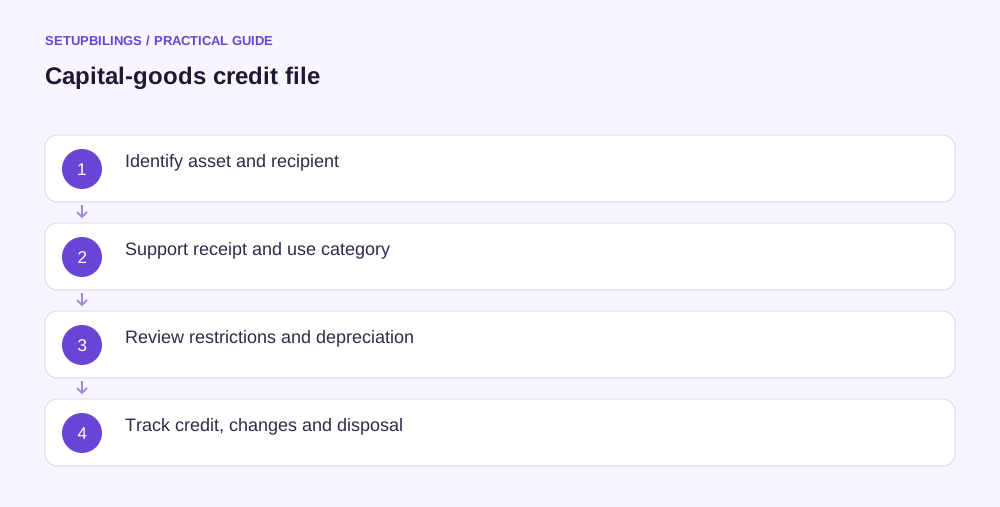
Establish that the purchase is capital goods
The GST definition concerns goods whose value is capitalised in the claimant's books and which are used or intended for business. Check the actual item and accounting treatment. A capitalised service or intangible cost is not automatically goods for every GST rule simply because it appears in the fixed-asset register.
Retain the invoice, contract and asset description and identify the correct recipient GSTIN. The entity paying, the entity owning the asset and the establishment using it can differ in a group. Resolve those facts before assuming the tax belongs to the registration with the largest output liability.
Connect acquisition, receipt and commissioning
Keep purchase order, delivery, inward entry, installation and commissioning records where relevant. Receipt and commissioning are related but distinct facts, so do not impose a universal commissioning-date rule without reviewing the actual supply and statutory condition. A machine delivered in several lots also needs the applicable last-lot analysis.
Where the supplier delivers directly to a project site or another person on the claimant's instruction, preserve that direction and delivery evidence. The statutory deemed-receipt rule can matter. Do not manufacture a warehouse receipt for an asset that legitimately moved directly to the installation location.
Illustratively, a manufacturer acquires a ₹12 lakh machine with GST shown separately, delivered in three consignments to its factory. The asset file should connect the invoice to the consignments and explain the relevant receipt date. An accounting entry for the whole machine on advance payment date does not alone establish the credit timing.
Review the asset-specific restrictions
Business use does not override section 17(5). Passenger vehicles, construction and other restricted categories require their own assessment. A fixed-asset label such as plant does not automatically establish that an immovable structure fits the statutory plant-and-machinery exception.
Construction-related assets need current wording, including the Finance Act 2025 amendment and its implementation. Prepare a component analysis where a project combines machinery, support work and buildings. A single capitalisation entry for an entire expansion can conceal amounts with different credit treatment.
Check personal and exempt-activity use. A capital asset exclusively supporting exempt supplies or non-business purposes differs from an asset used for taxable supplies. Record intended use at acquisition and actual changes over time so the selected credit treatment has a factual basis.
Separate initial eligibility from common-use adjustment
Do not assume all capital-goods credit must be claimed in equal instalments over five years. Rule 43 provides a particular common-capital-goods apportionment framework; it is not a universal instruction to divide every eligible machine invoice into sixty monthly claims.
Classify assets into the relevant use categories and assess initial credit under the applicable conditions. For common capital goods, retain the credit amount, invoice date, useful-life schedule for the rule and turnover inputs needed for recurring calculations. Separate those workings from ordinary book depreciation.
A change from exclusive to common use, or another category change, can require a specific adjustment. Preserve the change date and evidence instead of overwriting the asset's original status. An old machine moved to a new activity should not enter a schedule as if newly purchased merely because a department code changed.
Reconcile depreciation and tax cost
Section 16(3) restricts credit where depreciation is claimed on the tax component under the applicable income-tax framework. Keep a bridge between invoice cost, GST credit, capitalised amount and tax-depreciation base. Financial-statement depreciation and tax depreciation should be identified separately rather than assumed identical.
Do not assume that temporarily capitalising an unresolved GST amount settles the final tax treatment. If credit later becomes validly available or is finally denied, review the accounting and tax consequences through the proper process. Preserve the decision and adjustment history so the same tax amount is not supported by inconsistent records.
Capital assets acquired before registration or during a scheme transition need the particular special-credit provision reviewed. A new normal registration does not automatically unlock tax on every historical asset. Keep acquisition dates, prior use and registration timeline available before treating an amount as opening capital-goods credit.
Include a physical asset reference or serial number where available. Two machines from the same supplier can have different locations, receipt dates and use categories, making an invoice-level total insufficient for later changes. Link each asset to its allocated tax amount and explain the allocation if one invoice covers several assets. This also helps reconcile insurance, maintenance and disposal records without transferring a credit history to the wrong machine. If an asset is temporarily idle, record the reason and intended business use rather than assuming that idleness alone either confirms eligibility or requires the same adjustment as permanent reassignment.
Maintain an asset-level credit register
For each material asset, record invoice, GSTIN, location, receipt evidence, use category, tax by head, credit claimed, restriction reason and relevant return period. Link common-use schedules and later adjustments. The asset register should be able to explain the GST treatment without relying on the preparer's memory.
Match the proposed claim with supplier reporting and the applicable deadline. Check current return instructions and keep acknowledgements. A machine's long physical life does not extend a statutory first-claim deadline, and a successful statement match does not remove a blocked category.
Finally, review disposals, transfers and changes in use before the asset leaves the register. Those events can have separate GST consequences, including provisions concerning capital goods on which credit was taken. A complete capital-goods file follows the asset from acquisition through use and disposal, supporting both the initial claim and the later calculations that depend on it.
Sources and references
- CBIC: Central Goods and Services Tax Act, consolidated through August 2021
- CBIC: current CGST section 16, eligibility and conditions
- CBIC: current CGST section 17, apportionment and blocked credits
- CBIC CGST Rules compilation through September 2021
- CBIC: Rule 43, common capital goods
- Finance Act 2025, section 124: construction credit amendment
- CBIC Circular 170/02/2022-GST: reporting ITC and reversals