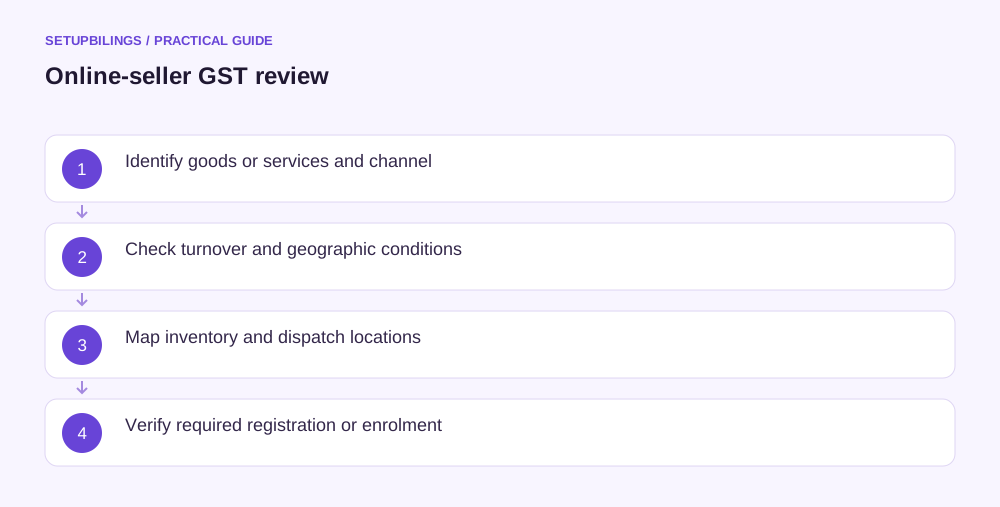
Online is a channel, not one tax category
A business selling its own goods through a website, supplying goods through a marketplace and providing services through an app can face different GST registration rules. Start with the actual supply and the platform's role. The fact that an order arrives online does not by itself establish compulsory registration or an exemption.
Identify the legal person selling, the goods or services, who invoices, who collects money and where supplies are made from. Keep platform terms and a sample customer transaction together. This makes it possible to assess the relevant section 24 provision and notifications without relying on a broad statement that “e-commerce always needs GST.”
Distinguish an own website from a marketplace
Where a business sells only its own inventory through its website, review the ordinary registration framework and any special facts. A website is not automatically the same as an operator collecting consideration for independent suppliers under section 52. Payment-gateway processing should also be distinguished from the operator role in the actual contract.
A marketplace selling model raises separate questions about the operator's TCS duty and the seller's registration obligation. Review both, rather than assuming the marketplace's registration covers each seller. The platform may impose commercial onboarding requirements, but those should not be confused with a statutory obligation applying universally to all online businesses.
For services, identify whether a notified section 9(5) arrangement applies or whether the relevant TCS-based service-seller provision and exemption is involved. The nature of the service matters. A goods-seller enrolment route should not be used for an unrelated service simply because the platform has a single onboarding page.
Review the small goods-seller exemption accurately
Notification 34/2023-Central Tax, effective 1 October 2023, provides a conditional registration exemption for qualifying goods suppliers through relevant e-commerce operators. The turnover condition concerns both the preceding and current financial years under the notification. The seller must meet the applicable registration-threshold test, not a single nationwide value selected from an advertisement.
The conditions include no inter-State goods supplies, supplies through the operator in only one State or Union territory, PAN validation and obtaining the portal enrolment number before the relevant supplies. The notification also addresses the effect of subsequent registration. A seller should keep evidence of the actual enrolment and geographic restrictions.
Illustratively, a home accessories seller plans ₹6 lakh of sales through a marketplace entirely within one State. It should check all exemption conditions and complete the required enrolment before relying on the route. If the business later enables nationwide delivery, the low turnover alone does not preserve an exemption conditioned on no inter-State goods supplies.
Do not repeat the old composition ban
Eligible composition taxpayers can make relevant goods supplies through e-commerce operators under the procedure effective from 1 October 2023. Notification 36/2023 requires the operator not to allow inter-State goods supplies through that route and to perform the specified TCS and GSTR-8 reporting. The seller still needs to satisfy the composition scheme's other conditions.
This is different from the unregistered small-seller exemption. A composition GSTIN and an unregistered seller's enrolment number identify different positions and should not be entered interchangeably. Service supplies through relevant operators require a separate restriction review, so do not extend the goods change to every online service model.
Set platform delivery areas and catalogues consistently with the chosen route. A legal eligibility note is not enough if software accepts orders the route does not permit. Give the person approving new categories and States a clear instruction to obtain a review before activating the change.
Map warehouses and dispatch points
Determine where inventory is physically stored and from where orders are supplied. A marketplace can move stock into several fulfilment centres, creating questions beyond the seller's original home-State registration. Obtain the actual location and stock-movement reports rather than judging from where the owner sits with a laptop.
A customer in another State and stock stored in another State are different facts. Review the State-specific registration position, premises evidence and branch transactions arising from the actual model. Do not automatically treat every destination State as needing a GSTIN, or assume an existing GSTIN covers every warehouse nationwide.
The October 2026 Council release recommended a further simplified registration mechanism for certain small sellers using ECO warehouses without physical presence. Check the implementing notification and rollout before relying on that proposal. A proposed future route should not be used to justify present inventory arrangements without the required legal basis.
Include sales from a physical counter in the same turnover review even if the online team cannot see them in its dashboard. A channel-specific report is useful for reconciliation, but it does not replace the PAN-wide registration calculation required by the relevant provision.
Reconcile sales before applying turnover tests
Use gross order and invoice records, supported cancellations and returns, then reconcile platform fees, TCS and payouts separately. A ₹20,000 sale followed by ₹1,500 of platform deductions is not automatically only ₹18,500 of turnover. Likewise, a refund needs a traceable sales adjustment rather than an unexplained reduction to the next bank settlement.
Combine relevant supplies under the same PAN across offline, own-site and marketplace channels. Keep a running current-year total and review triggers for new States, services, products and stock locations. A business can lose the factual basis for an exemption before its year-end accounts are finalised.
Choose registration or a valid exemption route only after this model is clear. A practical online-seller file contains the transaction map, turnover working, platform terms, location list and evidence of the chosen registration or enrolment. That makes the conclusion usable by the people who actually manage listings, deliveries and accounts.
Sources and references
- CBIC: Central Goods and Services Tax Act, consolidated through August 2021
- Notification 34/2023-Central Tax: conditional exemption for goods through ECOs
- Notification 36/2023-Central Tax: goods supplied through ECOs by composition taxpayers
- Notification 65/2017-Central Tax: conditional exemption for services through ECOs
- GSTN: Applying for normal taxpayer registration
- GST Council: Recommendations of the 57th meeting, 8 October 2026