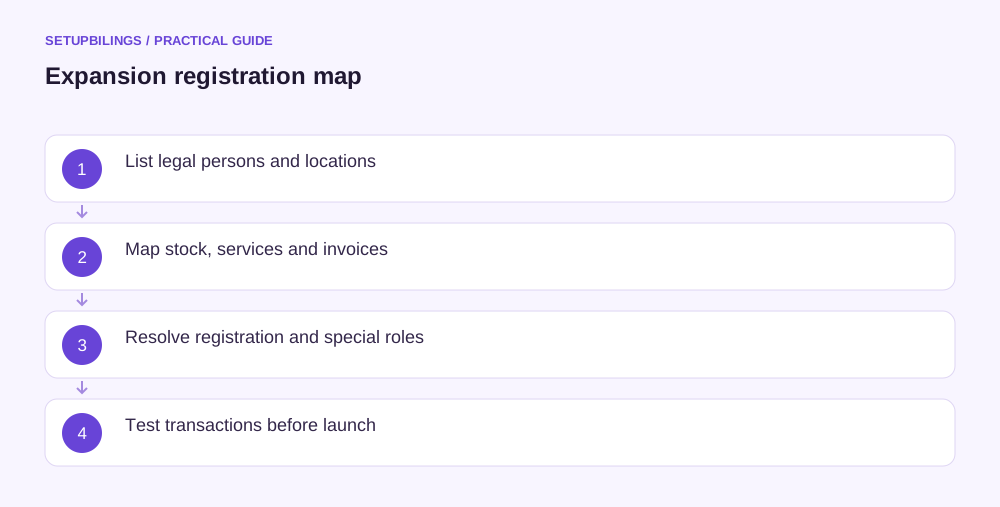
Build one map before departments make separate assumptions
Expansion can add a sales office, warehouse, fulfilment centre, factory or shared-service function. Each location has different facts, and a lease address alone does not determine the GST outcome. Start with one business-wide map that shows legal person, State, use of the premises, stock and the establishment making supplies.
The objective is to connect physical operations with tax registrations and documents. Purchasing may know where stock is stored, sales may know which branch issues invoices and finance may know only the existing GSTIN list. Bring those views together before launch rather than discovering after the first month that each team designed a different supply chain.
Use a location register with decision fields
| Field | Why it matters |
|---|---|
| Legal person and PAN | Establishes whose operation is being mapped |
| State and exact address | Identifies the relevant registration geography |
| Actual activities | Distinguishes storage, supply and support functions |
| Stock owner and dispatcher | Connects inventory with outward transactions |
| Registration decision | Records the conclusion and unresolved conditions |
Include outsourced and shared premises where relevant. Goods may be held in another State even when the business has no employee there. Obtain fulfilment-provider location reports and contracts rather than assuming the owner's office address is the only place that needs review.
Record opening and intended closure dates. A location can remain relevant during a transition while stock, customer returns or records are still held there. Avoid deleting the old premises from the map on the day the new lease is signed if business continues at both addresses for several weeks.
Distinguish State registration from additional premises
For an existing State registration, a genuine additional business location in that State may require an amendment review. A location in a different State calls for a separate assessment of registration liability there. Do not simply insert an out-of-State warehouse as another address under the original State GSTIN.
At the same time, selling to a customer in another State does not automatically require supplier registration in that destination State. Trace where the supply is made from and how goods move. Customer geography, place of supply and the supplier's operating establishments are related but separate parts of the analysis.
Review special cases, including SEZ units or developers, which have specific separate-registration treatment from an establishment outside the SEZ in the same State. Do not assume every same-State location can share the existing registration without considering that statutory distinction.
Trace stock movements and invoices together
Illustratively, a distributor operates a Maharashtra head office, holds ₹18 lakh of stock in a Karnataka warehouse and uses a second Maharashtra storage unit. The map should identify the owner and dispatch role of each site and review the Karnataka registration separately from the same-State additional-premises question.
Now list the intended movements: purchases delivered directly to each warehouse, transfers between locations, customer dispatches and returned goods. Link each flow to the proposed invoice issuer and GSTIN. A warehouse system that dispatches Karnataka stock while every invoice defaults to the original State requires examination before orders start moving.
Separate registrations under the same PAN are distinct persons for GST purposes. Supplies between such establishments can have tax consequences even without ordinary customer consideration under the relevant provisions. Review documentation, valuation, credit and movement requirements rather than treating every branch stock transfer as an accounting-only relocation.
Map central services and special roles
Expansion can also change the treatment of external services received centrally for other registrations. The revised ISD framework effective from 1 April 2025 requires review where an office receives input-service invoices for or on behalf of distinct persons. A central office should not assume its ordinary GSTIN can absorb and informally allocate all common input-service credit.
Keep this external credit-distribution question separate from services actually supplied between establishments. A general “head-office allocation” journal can contain different legal categories requiring different analysis. Identify the underlying supplier, invoice recipient and beneficiary registrations before choosing the records and process.
Other roles such as TDS, TCS or temporary event registration should also appear where the model creates them. The registration register should explain what each GSTIN is for, rather than listing numbers without distinguishing a normal supplier from a special deductor, collector or distributor role.
Add a document owner and review date to each unresolved location decision. A premises marked “to be confirmed” should not quietly become an approved dispatch point when warehouse staff begin using it. Agree what evidence or legal conclusion is still needed and check completion before activating that location in the order system. This creates a practical connection between the expansion map and the actual launch decision.
Prepare evidence and operational controls before launch
For each location requiring declaration or registration, organise the actual possession evidence. Ownership, rental, sharing and consent arrangements need the appropriate records. Confirm the legal applicant, unit, floor and validity dates against the form. A lease naming another group entity may require clarification of the real right to use the premises.
Assign responsibilities for application, authentication, signing, bank details, invoice masters and return calendar. Check the implemented portal process and current rules; an October 2026 Council recommendation for simplified e-commerce registration or amendment automation should not be treated as effective merely because a project plan anticipates it.
Test the first transaction for every material flow and reconcile the first reporting period by registration. Check invoices, stock records, purchase entries and credit allocations against the approved map. Maintain the map as operations change so later warehouses and sales channels receive the same factual review instead of inheriting an obsolete expansion assumption.
Sources and references
- CBIC: Central Goods and Services Tax Act, consolidated through August 2021
- CBIC: CGST Rules, official compilation including registration amendment rules
- CBIC Instruction 03/2025-GST, 17 April 2025
- Notification 16/2024-Central Tax: commencement of revised ISD provisions
- Finance Act 2024, section 12: substituted CGST section 20
- CBIC: current CGST section 20, including 2025 amendments
- GST Council: Recommendations of the 57th meeting, 8 October 2026